
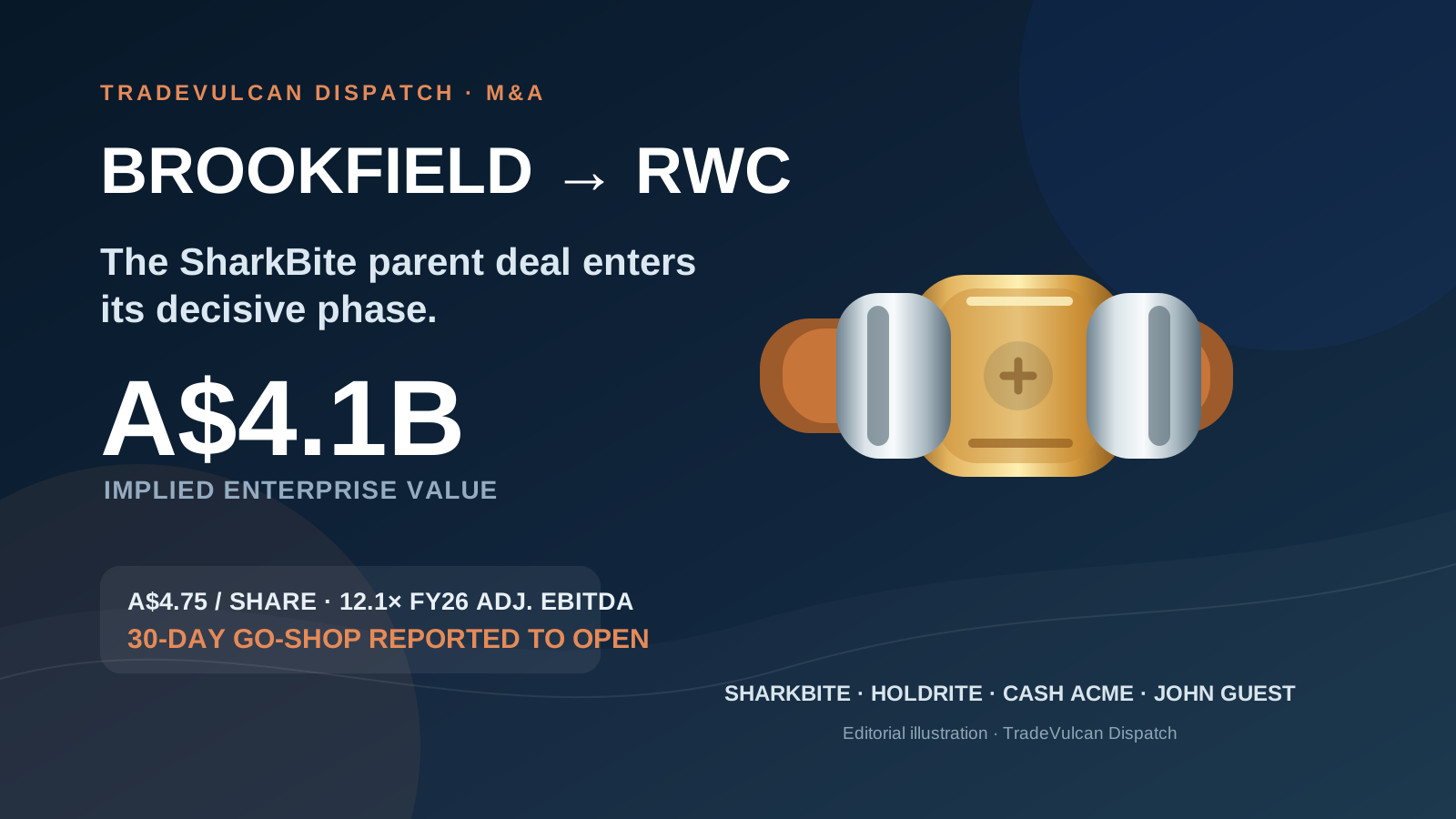
The fresh development: the Brookfield bid is reportedly moving from proposal to binding deal
The Australian reported on September 14 that Brookfield’s A$4.75-per-share bid for Reliance Worldwide Corporation has gone binding and that the plumbing-products company is beginning the 30-day “go-shop” process contemplated in the parties’ earlier process deed.
Reliance’s own public news and ASX-announcement pages had not yet posted a new Scheme Implementation Deed when TradeVulcan Dispatch checked them early September 14 Pacific time. The most recent company-posted deal announcement remained the August 18 process deed. Dispatch is therefore attributing the binding-status update to The Australian while treating the A$4.75 price, A$4.1 billion enterprise value, 31.6% premium, 12.1x FY26 adjusted-EBITDA multiple and 30-day go-shop framework as company-confirmed terms from August.
This article will be updated when Reliance posts the definitive agreement or if the reported status changes.
Private equity has spent billions buying contractors. This deal reaches one layer deeper—into the products those contractors install.
Reliance Worldwide is not a niche industrial name to a plumber. Its brands include SharkBite push-to-connect plumbing products, HoldRite engineered plumbing and mechanical solutions, Cash Acme valves, John Guest fittings, EZ-FLO and Eastman.
Brookfield’s proposed A$4.1 billion enterprise value—about US$2.9 billion when Reuters reported the proposal in August—puts a public number on the value of that brand portfolio, its manufacturing footprint and its position inside the repair, remodel, commercial and new-residential plumbing channels.
That makes the transaction useful well beyond the shareholder vote. It is a valuation signal for the infrastructure around the trades. The A1 Garage Door/KKR story showed how much capital will pay for a scaled service platform. Brookfield’s pursuit of Reliance shows how much institutional capital may pay for the manufacturer and distribution layer that sits behind thousands of daily service calls and installations.
For contractors, the operating lesson is not that a private-equity owner automatically means product-price increases. The better lesson is that brand trust, channel access, product mix, manufacturing geography and the ability to navigate tariffs and raw-material volatility have become strategic assets worth billions.
What contractors should know
- Brookfield’s proposal is A$4.75 cash per Reliance Worldwide share, implying approximately A$4.1 billion of enterprise value and a 12.1x FY26 adjusted-EBITDA multiple on the company’s post-AASB16 basis.
- The proposed price was a 31.6% premium to Reliance’s A$3.61 closing price on August 17 and followed earlier Brookfield approaches at A$4.15, A$4.25 and A$4.50.
- The Australian reported September 14 that the offer has gone binding and the agreed 30-day go-shop is opening; Reliance’s own public announcement page had not yet posted the definitive agreement when Dispatch checked early September 14 Pacific time.
- Reliance generated US$1.306 billion of FY26 net sales and US$242.1 million of adjusted EBITDA. Its Americas segment generated US$824.8 million of sales—roughly 63% of consolidated revenue.
- Reliance says FY26 earnings were pressured by U.S. tariffs, higher copper costs and softer Americas and EMEA volumes. It expects a US$5 million to US$7 million net U.S.-tariff impact in FY27.
- A new Mexico operation is expected to be operational by the end of 2026 to improve manufacturing flexibility and help mitigate U.S. tariff impacts, while the U.S. plant remains the company’s core high-volume, high-technology manufacturing site.
- For contractors, watch product availability, distributor programs, SKU strategy, warranty/service policy and manufacturing changes—not just the ownership headline.
Reliance Worldwide deal scorecard
- Proposed price
- A$4.75/share
- Enterprise value
- A$4.1B
- Premium
- 31.6%
- Deal multiple
- 12.1x
- FY26 net sales
- US$1.306B
- FY26 adjusted EBITDA
- US$242.1M
Cash offer.
About US$2.9B when Reuters reported the proposal in August.
Versus the A$3.61 close on August 17.
FY26 adjusted EBITDA, post-AASB16 basis.
Down 0.7% reported; underlying sales up 1.5% after company adjustments.
Down 12.8% year over year.
The deal math says the plumbing-products layer can command a premium multiple
Reliance’s August 18 announcement put unusually clean public numbers around the proposal. Brookfield’s A$4.75 cash offer represented a 31.6% premium to the prior close, 32.8% above the three-month volume-weighted average price and 43.2% above the six-month VWAP.
The company calculated an enterprise value of approximately A$4.1 billion and a 12.1x FY26 EV-to-adjusted-EBITDA multiple on a post-AASB16 basis, or 12.9x pre-AASB16. Reuters translated the enterprise value to about US$2.91 billion at the time.
Those are meaningful numbers because Reliance is not being valued on a hypergrowth software story. FY26 reported net sales were US$1.3056 billion, down 0.7%, while adjusted EBITDA fell 12.8% to US$242.1 million. Reported net profit dropped to US$6.3 million after US$103.3 million of post-tax one-off charges tied primarily to the company’s Asia-Pacific manufacturing restructuring and related goodwill impairment.
Brookfield’s persistence matters. Reliance disclosed earlier unsolicited proposals at A$4.15, A$4.25 and A$4.50 before the A$4.75 proposal arrived after roughly eight weeks of due diligence. The proposed purchase price therefore did not emerge from a single speculative approach; it followed several increases and access to non-public company information.
For a contractor owner, the lesson is not to apply a 12.1x public-company multiple to a local plumbing business. The lesson is what institutional buyers appear willing to pay for a combination of brand, channel position, manufacturing capability, global scale and cash-generating products that sit close to recurring repair and replacement demand.
Why SharkBite matters to the thesis
Reliance’s portfolio reaches into several different parts of the plumbing job. SharkBite is associated with push-to-connect fittings and pipe systems. HoldRite sells engineered plumbing and mechanical support solutions. Cash Acme focuses on valves. John Guest and JG Speedfit extend the company into additional push-to-connect and fluid-handling applications, while EZ-FLO and Eastman broaden the repair and installation catalog.
That matters because branded products can influence a contractor’s work before a manufacturer ever sees the end customer. The product has to be available at the supply house or retailer, familiar to the technician, code-appropriate for the job, fast enough to install and reliable enough that the contractor is willing to put a warranty behind the work.
A strong trade brand therefore compounds through more than advertising. It can become part of the technician’s muscle memory, the truck-stock list, distributor purchasing, training and the company’s preferred repair method.
Reliance’s own investor materials position its brands across repair/remodel, commercial and new residential markets. That diversification is particularly important in a softer housing cycle: a manufacturer with meaningful repair and remodel exposure is not dependent on new-home starts alone.
The most important operating detail may be tariffs and copper—not private equity
Reliance’s FY26 results show why manufacturing geography has become a strategic variable. The company said adjusted EBITDA was pressured by U.S. tariffs, higher copper costs, lower volumes in the Americas and EMEA, and broader cost inflation. Price actions and US$10 million of cost savings offset part of that pressure.
Its Americas segment generated US$824.8 million of FY26 net sales and US$161.4 million of adjusted EBITDA. Reported Americas revenue was down 4%, although Reliance said underlying sales were up 1.4% after adjusting for tariff-related revenue provisions, customer-incentive accounting and the exit from low-margin Canadian product lines. Second-half underlying Americas sales were up 8.3%.
The company is also changing where it makes product. Reliance says a new Mexico facility is expected to be operational by the end of 2026. It describes the plant as complementary to U.S. manufacturing, focused on lower-volume manually assembled products that are less suited to automation, while the U.S. facility remains the core of high-volume, high-technology manufacturing. Reliance explicitly says the Mexico operation should help mitigate U.S. tariff impacts.
In Europe, a Poland facility has been ramping production, while the company has restructured metals manufacturing in Australia. These moves predate any completed Brookfield transaction. They are evidence that product cost, tariff exposure and factory location are already management-level strategic questions.
That is the contractor implication to watch. A change in ownership may affect capital allocation, but the price and availability of plumbing products can move because of copper, tariffs, freight, plant utilization, sourcing and product mix even before a sponsor changes anything.
The go-shop is not legal fine print. It is the next price-discovery event.
Reliance’s August process deed gave Brookfield exclusivity through September 15 while the parties worked toward a Scheme Implementation Deed. In exchange, Brookfield agreed that any definitive SID signed during that period would include a 30-day go-shop.
That structure matters because a go-shop temporarily changes the seller’s posture. Rather than merely waiting for an unsolicited bidder, Reliance would be allowed to solicit third-party interest, provide due diligence and negotiate an alternative proposal during the agreed window.
The Australian’s September 14 report says that window is now opening following a binding Brookfield offer. If another financial sponsor or strategic buyer believes Reliance is worth more than A$4.75 per share, this is the period in which that view can become an actionable bid.
There is also a major shareholder to watch. The Australian reported that AustralianSuper had increased its Reliance stake to 14.68%. A large holder does not automatically mean opposition, but a concentrated shareholder can matter in a scheme transaction, particularly if the market begins debating whether the current price captures enough of the company’s recovery potential.
The exact definitive conditions, timetable, break fees and recommendation language should be taken from Reliance’s SID once it is posted—not inferred from the August process deed.
What Brookfield is bidding for
| Asset | Confirmed public detail | Why it matters to contractors |
|---|---|---|
| Brand portfolio | SharkBite, HoldRite, Cash Acme, John Guest, EZ-FLO, Eastman and additional RWC brands | Brand preference can influence truck stock, installation method, warranty confidence and distributor demand. |
| FY26 revenue | US$1.3056 billion consolidated | The business has scale across multiple end markets rather than depending on one local housing cycle. |
| Americas | US$824.8 million of FY26 sales | North America is the largest operating region and puts U.S. contractors close to the center of the investment case. |
| Manufacturing | U.S. core plant, Mexico facility expected by end-2026, Poland ramp, APAC restructuring | Factory geography affects tariff exposure, lead times, cost structure and product availability. |
| Raw materials | Higher copper costs pressured FY26 earnings | Input volatility can move contractor material cost even when labor and demand are unchanged. |
| FY27 tariff outlook | US$5M–US$7M estimated net U.S.-tariff impact | Tariffs remain a live operating variable rather than a one-quarter accounting issue. |
What a plumbing contractor should actually watch if Brookfield wins
The wrong reaction is to assume the day a private-equity deal closes, every SharkBite or Cash Acme SKU gets more expensive. The acquisition does not prove that. Product pricing will continue to reflect raw materials, tariffs, competition, distributor negotiations, freight, manufacturing efficiency and demand.
The better approach is to watch the operating signals that can affect field economics. Does Reliance continue accelerating U.S. and Mexico capacity? Does it simplify or expand the SKU portfolio? Do distributor programs change? Does warranty support improve or tighten? Does the company use acquisitions to add adjacent categories? Do new products increase labor productivity enough to offset a higher unit price?
Contractors should also separate list-price movement from installed-job economics. A fitting that costs a few dollars more but saves meaningful installation time can still improve gross profit. Conversely, a small product increase can become painful when multiplied across thousands of service calls, especially if the price book is not updated quickly.
This is why the supply chain deserves the same attention as lead cost and labor cost. The contractor’s gross margin is built from all three.
Five operator moves while the plumbing supply chain keeps consolidating
- Ask primary distributors how frequently manufacturer cost changes are flowing into your account and whether quoted material prices have expiration windows.
- Audit the top 25 plumbing SKUs by annual spend, not just the largest-ticket equipment. Small fitting, valve and connector changes compound at volume.
- Track install-time economics alongside unit price. A product that lowers labor minutes, callbacks or rework can justify a higher material cost.
- Maintain approved alternates for high-volume categories so one manufacturer or one supply-chain disruption does not dictate your field capacity.
- Update price books on a defined cadence and compare actual material gross margin to estimate assumptions. Ownership headlines matter less than the dollars leaking out of unpriced cost changes.
A1 showed the value of the service platform. Reliance shows the value of the ecosystem around it.
The home-services consolidation story is becoming broader than contractor roll-ups. Capital is moving through service businesses, manufacturers, distributors, financing companies, software and the infrastructure that connects demand to completed work.
KKR’s roughly $2 billion A1 Garage Door transaction put a large number on a scaled residential service brand. Brookfield’s proposed A$4.1 billion Reliance transaction puts another large number on a product platform whose brands sit inside the technician’s daily workflow.
The valuation drivers are different, but the common thread is control of an important part of the contractor economy. A service platform controls customer acquisition, labor deployment and local density. A product platform controls intellectual property, manufacturing, brand preference, distribution and a piece of the material bill on every job.
That distinction is useful for independent operators. Enterprise value is created not only by getting larger, but by becoming harder to replace. For a contractor, that may mean a dense membership base, strong local brand, proprietary lead engine, trained workforce or unusually strong close rates. For a manufacturer, it may mean products, patents, factory scale and a brand technicians trust enough to use without hesitation.
Brookfield, Reliance Worldwide and SharkBite: quick answers
Is Brookfield buying SharkBite?
Brookfield is pursuing Reliance Worldwide Corporation, the parent company whose brands include SharkBite, HoldRite, Cash Acme, John Guest, EZ-FLO and Eastman. The proposed transaction is for Reliance Worldwide, not a stand-alone purchase of SharkBite.
How much is the Reliance Worldwide deal worth?
Reliance said Brookfield’s A$4.75-per-share proposal implied an enterprise value of approximately A$4.1 billion. Reuters described that as about US$2.91 billion when the proposal was announced in August 2026.
Is the Brookfield deal final?
The Australian reported on September 14 that Brookfield’s offer has gone binding and the 30-day go-shop is opening. Reliance’s public investor page had not yet posted the definitive Scheme Implementation Deed when Dispatch checked early September 14 Pacific time, so the binding status is attributed to that report pending the company filing.
What does the deal mean for plumbing contractors?
There is no announced contractor pricing change tied to the transaction. The practical things to watch are product pricing, distributor programs, product availability, manufacturing-footprint changes, SKU strategy, warranty support and whether new ownership accelerates adjacent acquisitions or product investment.
The next battle is not only for the contractor. It is for the products inside the truck.
The biggest home-services capital stories increasingly sit on both sides of the service invoice. Sponsors are buying the companies that answer the call, dispatch the technician and perform the work. They are also targeting the manufacturers and infrastructure providers that supply the job.
Brookfield’s pursuit of Reliance Worldwide is a particularly clear example because SharkBite and its sister brands are already familiar on plumbing trucks and supply-house shelves. An A$4.1 billion enterprise value says that familiarity, combined with manufacturing and channel reach, is a strategic asset.
The next 30 days may determine whether Brookfield gets the company at A$4.75 per share or a rival decides Reliance is worth more. For contractors, the longer-term question is more practical: who owns the products, where they are made, what they cost and whether they help a technician finish the job faster and more profitably.
That is where a multibillion-dollar M&A headline eventually reaches the service call.
Methodology
TradeVulcan Dispatch reviewed Reliance Worldwide's August 18 process-deed announcement, FY26 results presentation and public brand materials; Reuters' August 17 reporting on the proposal; and The Australian's September 14 report that the Brookfield offer had become binding and the 30-day go-shop was opening. At the time of publication early September 14 Pacific time, Reliance's public news and ASX-announcement pages still showed the August 18 process deed as the latest transaction announcement, so Dispatch attributes the binding-status update to The Australian rather than presenting it as a company-filed fact. Financial figures use the currencies and accounting bases stated by Reliance. Contractor implications are Dispatch analysis and do not predict Brookfield's future pricing, product or distribution decisions.
Sources
- RWC Enters Into Process Deed with Brookfield Capital Partners LLC — Reliance Worldwide Corporation
- Reliance Worldwide 'go shop' hunt on as Brookfield bid goes binding — The Australian
- Brookfield targets Australia's Reliance again with $2.9 billion bid — Reuters
- FY26 Full Year Results Presentation — Reliance Worldwide Corporation
- RWC Acquires EZ-FLO International, Makers of EZ-FLO and Eastman Products — Reliance Worldwide Corporation