
Status check — September 15, 2026
The U.S. Court of Appeals for the Ninth Circuit has declined to rehear the challenge to South Coast Air Quality Management District Rule 1146.2 before a larger panel of judges. The California Apartment Association, one of the appellants, reported the development on September 14 and said the denial leaves the court's July 2 decision in place without changing the rule's compliance schedule. A Public Health Law Center litigation tracker dates the denial order to September 9.
The practical status is clear: Rule 1146.2 remains in force. The first zero-emission requirement already took effect January 1, 2026 for Phase I equipment installed in new buildings. The plaintiffs have not announced a successful further appeal or stay that suspends the rule. The California Apartment Association says the coalition is reviewing its remaining options.
For contractors, the legal fight is now a job-scoping problem
Rinnai America, Noritz America and a coalition that includes the National Association of Home Builders, California State Pipe Trades Council and Plumbing-Heating-Cooling Contractors of California challenged South Coast AQMD's amended Rule 1146.2 as federally preempted.
A divided Ninth Circuit panel rejected that argument on July 2. The majority held that the Energy Policy and Conservation Act does not preempt this emissions rule because South Coast AQMD adopted it to meet Clean Air Act air-quality obligations. Judge Kenneth Lee dissented and argued that the court's earlier Berkeley gas-ban precedent should control.
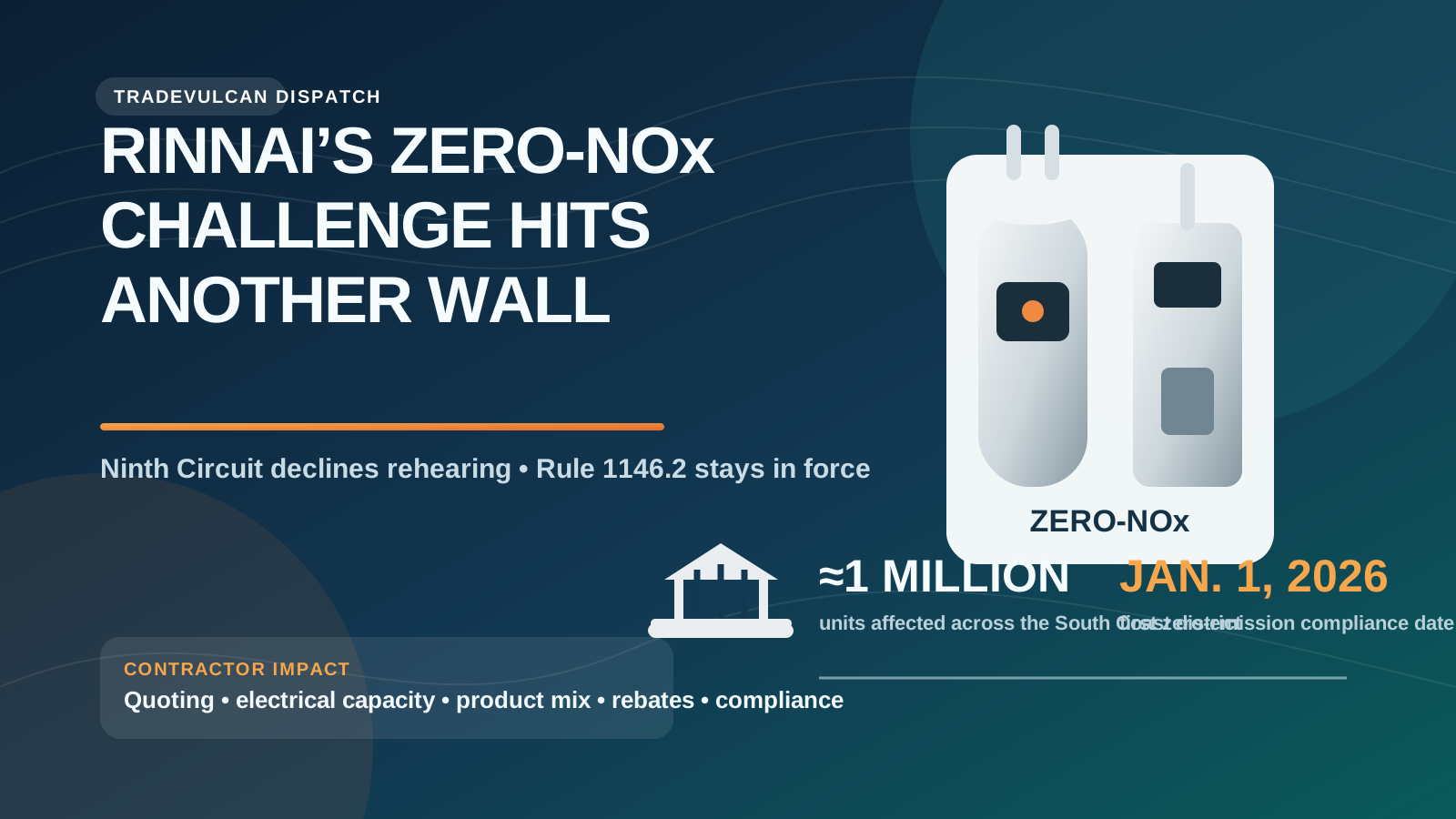
The failed rehearing effort matters because the rule is already moving from courtrooms into estimates, equipment selection and electrical planning. South Coast AQMD says the amendments affect about one million units in its four-county jurisdiction, including approximately 710,000 natural-gas pool and spa heaters.
The rule is not a blanket prohibition on every gas water heater in Southern California. It applies to specified water heaters, boilers and process heaters up to 2 million Btu per hour, with important category, size, building-type and exemption details. Contractors who reduce it to a political slogan risk giving customers the wrong answer on a real job.
What contractors need to know now
- The Ninth Circuit's July 2 ruling upholding Rule 1146.2 remains intact after the rehearing request was denied.
- South Coast AQMD says the rule amendments affect about 1 million units across Orange County and major portions of Los Angeles, Riverside and San Bernardino counties.
- Phase I zero-emission requirements for covered equipment in new buildings took effect January 1, 2026. Existing-building Phase I requirements begin January 1, 2029.
- Rule 1146.2 does not cover every residential gas water heater. Units subject to South Coast AQMD Rule 1121 are expressly exempt from Rule 1146.2.
- Residential structures are exempt from the rule's age-based mandatory operation provisions, but covered equipment installed after the applicable compliance date still has to meet the installation standard.
- The rule includes alternative compliance pathways for emergencies, multiple-unit replacements and certain construction or electrical-upgrade delays.
- South Coast AQMD's GO ZERO single-family rebate funding is currently depleted, multifamily pilot funding is fully reserved, and the agency says full initial funding remains available for small-business rebates.
The Rule 1146.2 contractor scorecard
- Affected units
- ~1M
- Pool/spa heaters
- ~710K
- First compliance date
- Jan. 1, 2026
- Final existing-building phase
- Jan. 1, 2033
- GO ZERO pilot
- $21M
- Small-business HPWH rebate
- $4,000
South Coast AQMD estimate across its four-county jurisdiction.
Natural-gas residential pool and spa heaters included in the agency's affected-unit estimate.
Phase I equipment in new buildings.
Phase III existing-building compliance date.
South Coast AQMD incentive program for zero-emission space and water heating.
Current published pilot amount per qualifying heat pump water heater, subject to program terms and funding.
This is not a generic 'gas water-heater ban'
Rule 1146.2 applies to manufacturers, distributors, retailers, resellers, installers, owners and operators of covered natural-gas-fired units with rated heat input up to 2 million Btu per hour. The categories include certain large water heaters, tankless water heaters, pool heaters, small boilers and process heaters.
That scope matters because South Coast AQMD has separate rules for other equipment. Rule 1146.2 expressly exempts units subject to Rule 1121, which regulates residential-type natural-gas water heaters. A contractor therefore cannot determine compliance by hearing the words "gas water heater" and stopping there. Input rating, equipment type, building type, installation date and the applicable South Coast rule all matter.
The amended rule sets zero-NOx and zero-CO limits for the covered categories and phases them in over several years. Before the applicable zero-emission date, covered gas equipment generally remains subject to the existing low-NOx certification limits. After the relevant compliance date, new covered equipment manufactured, supplied, sold or installed for use in the district must meet the zero-emission standard unless an exemption or alternative compliance path applies.
Rule 1146.2 zero-emission schedule
| Phase | Covered categories | New buildings | Existing buildings |
|---|---|---|---|
| Phase I | Type 1 units; instantaneous water heaters ≤200,000 Btu/hr | Jan. 1, 2026 | Jan. 1, 2029 |
| Phase II | Instantaneous water heaters >200,000 Btu/hr; Type 1 pool heaters; Type 2 units | Jan. 1, 2028 | Jan. 1, 2031 |
| Phase III | Type 1 and Type 2 high-temperature units | Jan. 1, 2029 | Jan. 1, 2033 |
The legal question was federal preemption. The contractor question is what can be installed on the next job.
The plaintiffs argued that the federal Energy Policy and Conservation Act preempted South Coast AQMD's rule because the federal statute limits state and local regulation concerning energy use of covered appliances. They pointed to the Ninth Circuit's earlier decision involving Berkeley's natural-gas infrastructure ordinance.
The July 2 majority drew a distinction. It treated Rule 1146.2 as an emissions-control measure adopted under the Clean Air Act framework rather than an energy-efficiency standard. The opinion also noted that process heaters covered by the rule are not all federally covered products, which created an additional problem for the plaintiffs' facial challenge.
Judge Lee dissented. He wrote that the Berkeley precedent controlled and that the South Coast rule effectively regulates energy use of federally covered products. The split matters because it shows the legal question was not trivial, and the failed rehearing request does not make the underlying policy controversy disappear.
For shops bidding work today, however, the absence of a stay is more important than the debate. The panel decision stands, the compliance calendar remains intact, and the first phase is already operative. Contractors should price and design jobs around the rule that exists today—not around the possibility that a future court could change it.
The hidden line item is electrical capacity
A rule that pushes covered equipment toward zero-emission alternatives can turn a plumbing or boiler replacement into a multi-trade project. The appliance itself may be only one part of the scope. Electrical service capacity, branch circuits, disconnects, condensate routing, equipment location, structural access and utility coordination can determine whether the replacement is straightforward or expensive.
South Coast AQMD built that reality into the rule. Its emergency-replacement provisions contemplate situations where a failed unit needs a short-term replacement because an electrical upgrade is required before a compliant unit can operate. For certain nonresidential buildings, the rule allows a temporary unit meeting the prior emission limits for up to six months if reporting and replacement conditions are met. Other alternative-compliance provisions address multiple-unit replacements and construction delays.
That does not mean every emergency automatically qualifies. It means the estimator needs to know the rule well enough to identify when an alternative path may exist and document it before promising a customer that a like-for-like gas replacement can simply go back in.
Residential and commercial customers do not face the same lifecycle rules
The rule assigns 15-year or 25-year unit ages to several equipment categories and generally restricts operation of covered noncompliant equipment after the applicable compliance date once the unit reaches the specified age. That sounds like a mandatory retirement schedule—but the exemptions matter.
Units installed or used in residential structures are exempt from the age-based operating provisions. In practical terms, the rule does not force a homeowner in a qualifying residential structure to remove an otherwise functioning covered unit solely because it reaches the listed age. The installation restrictions still matter when the covered equipment is replaced after the applicable compliance date.
Small businesses receive a narrower protection. A qualifying small business can be exempt from the age-based operation requirement if it registers through the compliance portal and satisfies the rule's small-business provisions. That distinction should be built into commercial account reviews: ownership status, employee count, receipts, unit age and equipment category can change the compliance path.
The rebate picture changed while the lawsuit was moving through court
South Coast AQMD's GO ZERO program is a $21 million pilot designed to help single-family, multifamily and small-business customers replace gas space- and water-heating equipment with heat pumps. It also funds installer training and application assistance.
The current funding picture is uneven. South Coast AQMD says single-family rebate funding is fully depleted and new applications are no longer being accepted. Multifamily pilot funding is fully reserved. The agency says full initial funding remains available for small-business rebates. Its current published small-business amount is $4,000 per qualifying heat pump water heater replacing gas or propane water heating.
That makes rebate verification a live sales task, not boilerplate. A proposal written from last month's incentive sheet can already be wrong. Contractors should confirm funding status when the quote is produced and again before representing an incentive as available to the customer.
The program also creates a training opportunity. South Coast AQMD is funding installer education around heat-pump systems. For plumbing companies that have historically stopped at the water connection, the shift toward heat-pump water heating increases the value of electrical coordination, load assessment and commissioning skills.
What a contractor should do before the next covered replacement
- Confirm the job is inside South Coast AQMD jurisdiction before applying the rule to the estimate.
- Identify the exact equipment category, rated heat input and whether another South Coast rule—especially Rule 1121—controls instead.
- Check whether the project is a new or existing building and which Phase I, II or III date applies.
- For an existing unit, document model, serial number and manufacture date when available; unit age matters for nonresidential lifecycle provisions.
- Evaluate electrical service and branch-circuit capacity before presenting a zero-emission replacement as a simple appliance swap.
- If the job involves a sudden failure, multiple units or construction delay, review the rule's alternative-compliance provisions before promising a temporary replacement path.
- Verify GO ZERO and other rebate funding at the time of sale rather than quoting a stale incentive amount.
- Train dispatchers and CSRs to avoid saying 'gas is banned' or 'gas is still allowed' without first identifying the equipment and project context.
This is a sales-process change as much as a code change
The companies that handle this transition best will not lead with ideology. They will lead with options, scope and certainty.
A customer calling about a failed boiler or tankless water heater wants to know what can be installed, how fast, what it will cost and whether another trade has to get involved. A contractor who can answer those four questions accurately has an advantage over one who discovers the electrical or compliance issue after the equipment is ordered.
That suggests a different estimate structure for covered projects: existing-equipment verification, compliance classification, electrical-capacity assessment, replacement options, rebate check, permit/AHJ assumptions and a clear contingency if site conditions change. The more complicated the regulatory environment becomes, the more valuable a disciplined preconstruction process becomes.
It also changes lead qualification. A commercial customer with aging equipment may be worth a proactive asset review years before a failure. A property manager with multiple boilers may need a phased capital plan. A pool-service relationship may create a future electrification opportunity once Phase II deadlines arrive. Regulation can create demand, but only if the contractor builds a process to identify it.
The courtroom fight may continue. The compliance calendar does not wait.
The California Apartment Association says the plaintiffs are reviewing their options after the rehearing denial. A petition asking the U.S. Supreme Court to review the case is one procedural possibility in federal litigation, but Dispatch found no announced Supreme Court filing or stay as of publication.
South Coast AQMD, meanwhile, built a technology review into the rule for 2027 and retains later compliance dates stretching through 2033. That leaves room for implementation details, product availability and incentive policy to evolve even if the core legal holding remains intact.
For contractors, waiting for absolute certainty is not a strategy. Phase I is already here. The next useful move is to know which jobs the rule actually covers, make electrical and product availability part of the estimate, and track the later phases before they turn into emergency training.
Rule 1146.2 questions contractors are asking
Did the Ninth Circuit invalidate Rule 1146.2?
No. The Ninth Circuit affirmed the district court on July 2, 2026 and held that the Energy Policy and Conservation Act does not preempt South Coast AQMD's amended Rule 1146.2. The rehearing request was later denied, leaving that panel decision in place.
Does Rule 1146.2 ban every gas water heater in Southern California?
No. The rule covers specified water heaters, boilers and process heaters up to 2 million Btu per hour, and it contains category and exemption provisions. Units subject to South Coast AQMD Rule 1121 are expressly exempt from Rule 1146.2.
When do the zero-emission requirements start?
Phase I for covered equipment in new buildings began January 1, 2026. Phase II new-building requirements begin January 1, 2028, Phase III new-building requirements begin January 1, 2029, and existing-building dates run from 2029 through 2033 depending on equipment category.
Are rebates still available?
South Coast AQMD currently says GO ZERO single-family funding is depleted and multifamily pilot funding is fully reserved. The agency says full initial funding remains available for small-business rebates, including a published $4,000 amount per qualifying heat pump water heater, subject to program rules and funding.
Methodology
Dispatch reviewed the Ninth Circuit's published July 2, 2026 opinion, South Coast AQMD's current Rule 1146.2 text and compliance schedule, the California Apartment Association's September 14 rehearing update, the Public Health Law Center litigation tracker, and South Coast AQMD's current GO ZERO funding pages. The article distinguishes the appellate ruling from the later rehearing denial and treats South Coast AQMD's equipment counts and rebate amounts as agency estimates and program terms. Rule 1146.2 contains detailed definitions, exemptions and alternative-compliance provisions; contractors should confirm project-specific applicability with the governing agency and authority having jurisdiction rather than relying on a general news summary.
Sources
- Ninth Circuit declines to rehear South Coast gas appliance rule challenge — California Apartment Association
- Rinnai America Corp. v. South Coast Air Quality Management District, No. 25-5129 — U.S. Court of Appeals for the Ninth Circuit
- Rule 1146.2 — Emissions of Oxides of Nitrogen from Large Water Heaters and Small Boilers and Process Heaters — South Coast Air Quality Management District
- South Coast AQMD Approves Rule to Accelerate the Transition to Zero-Emission for Building Water Heaters — South Coast Air Quality Management District
- 2026 Rule Compliance Deadlines — South Coast Air Quality Management District
- GO ZERO Pilot Incentive Program — South Coast Air Quality Management District
- GO ZERO FAQs — South Coast Air Quality Management District
- Rinnai America Corp. v. South Coast Air Quality Management District — litigation tracker — Public Health Law Center