
Status check — September 14, 2026
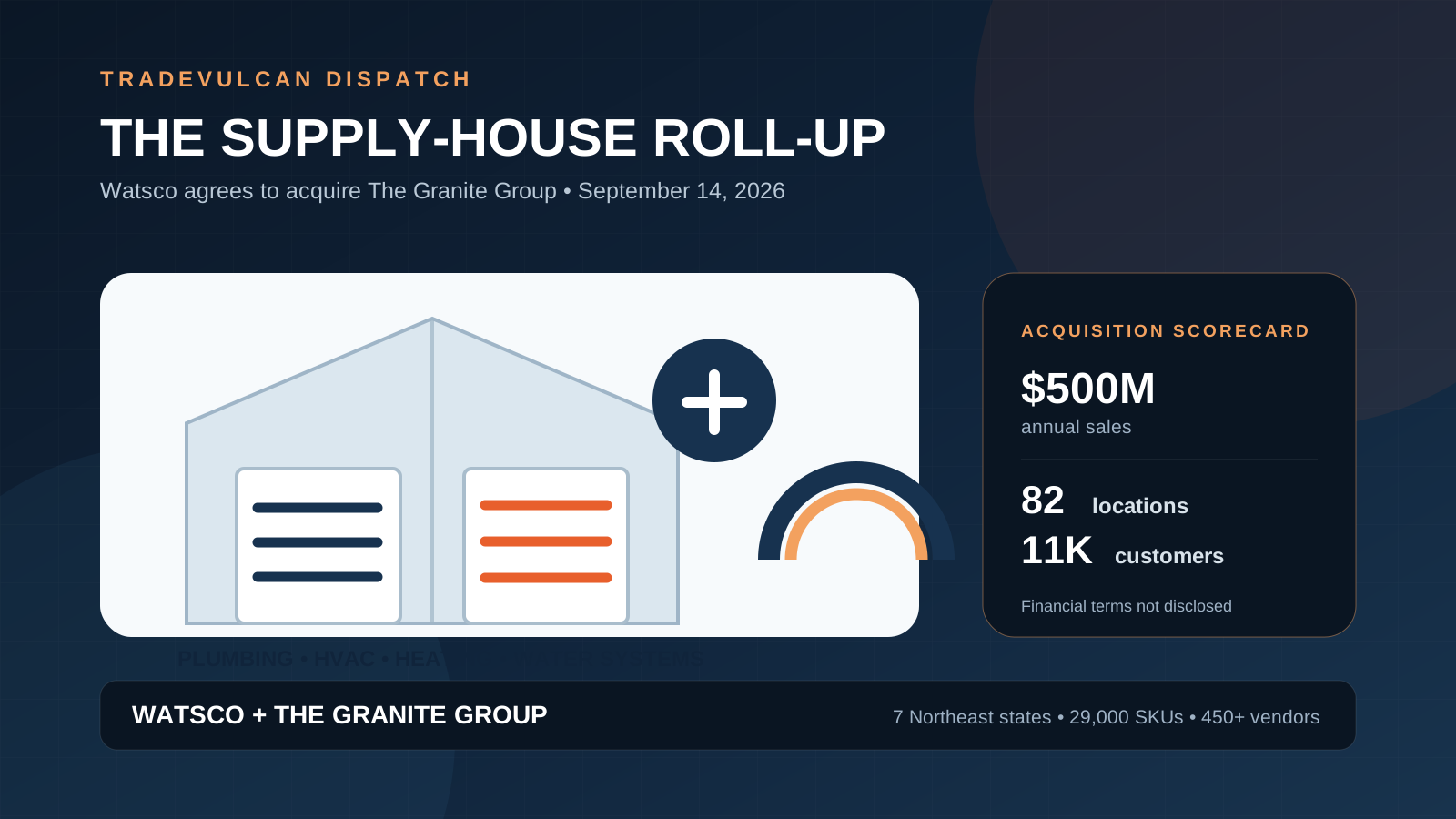
Watsco announced Monday that it has entered into an agreement to acquire The Granite Group, a Concord, New Hampshire-based distributor of plumbing and HVAC products with approximately $500 million in annual sales. The transaction is subject to customary closing conditions and regulatory approvals. Watsco did not disclose the purchase price or an expected closing date.
The Granite Group is expected to continue operating as an independent business under its existing management team led by CEO Bill Condron. That detail matters: this is an agreed acquisition, not a completed integration, and Dispatch found no company disclosure supporting a transaction-value estimate. The $500 million figure in this article refers to The Granite Group's annual sales, not the amount Watsco is paying.
Home-services consolidation is moving one layer upstream—from the contractor to the counter where the contractor buys the job.
The most visible roll-ups in the trades have focused on service companies: HVAC platforms buying local HVAC shops, plumbing groups buying plumbers, and garage-door platforms assembling regional brands.
Watsco's agreement to acquire The Granite Group is a reminder that the same consolidation logic is playing out in distribution. The target serves roughly 11,000 customers from 82 locations across New Hampshire, Vermont, Maine, Massachusetts, Connecticut, Rhode Island and New York. It carries about 29,000 SKUs from more than 450 vendors and has compounded sales at approximately 10% annually since 2010, according to Watsco.
Watsco is already the largest HVAC/R distributor in North America. It generated $7.24 billion of revenue in 2025 and operated 695 locations at year-end. The Granite Group deal would give it a much larger plumbing footprint in the Northeast while preserving the local management structure that made the target valuable in the first place.
For contractors, the headline is not simply that another family business is selling. It is that scale, branch density, digital tools, vendor relationships and purchasing power are becoming strategic assets on both sides of the service truck.
What contractors should know
- Watsco agreed September 14 to acquire The Granite Group, a third-generation plumbing and HVAC distributor with approximately $500 million in annual sales.
- The Granite Group serves about 11,000 customers from 82 locations across seven Northeast states and carries roughly 29,000 SKUs from more than 450 vendors.
- Watsco says The Granite Group has produced a 10% compound annual sales growth rate since 2010 through acquisitions and more than 30 new store openings.
- Financial terms were not disclosed. The $500 million headline figure is The Granite Group's annual sales, not the acquisition price.
- The Granite Group is expected to remain independently operated under CEO Bill Condron and the current management team after closing.
- Watsco closed the acquisition of Jackson Supply Company on June 1, adding roughly $230 million in annualized sales and 25 Sunbelt locations. Granite and Jackson together represent about $730 million of disclosed annual or annualized sales and 107 locations.
- Watsco says more than 70,000 contractors and technicians use its digital platforms, making technology deployment part of its acquisition playbook—not just branch purchasing power.
The Granite Group acquisition scorecard
- Granite annual sales
- $500M
- Granite locations
- 82
- Granite customers
- ~11,000
- Granite assortment
- ~29,000 SKUs
- Sales CAGR since 2010
- 10%
- Purchase price
- Undisclosed
Approximate annual sales disclosed by Watsco.
Across seven Northeast states.
Customer count disclosed by Watsco.
Sourced from more than 450 vendors.
According to Watsco; driven by acquisitions and 30+ new locations.
Do not confuse target revenue with transaction value.
The next roll-up is the supply house
The service trades are fragmented by design. Local operators win because they know the territory, the customers, the inspectors and the equipment. Distribution has historically looked much the same: regional supply houses built dense branch networks, local relationships and a line card tuned to what contractors in that market actually install.
That fragmentation creates an acquisition opportunity. A larger buyer can add capital, national vendor relationships, inventory systems, e-commerce and analytics without necessarily erasing the local brand. Watsco's stated model is explicitly built around that premise. It says it identifies strong distribution businesses, supports existing leadership, preserves culture, funds aggressive growth and then deploys customer-facing technology across the acquired company.
The Granite Group looks almost purpose-built for that model. Its public history stretches back to 1971. The company expanded through acquisitions and branch openings, entered New York this year, and operates a broad mix of plumbing, heating, cooling, piping, water-system and energy-product branches plus decorative showrooms.
That combination matters to a strategic buyer because branch density is difficult to recreate quickly. Opening one warehouse is easy compared with building decades of contractor relationships, local purchasing patterns, credit histories, vendor agreements and experienced counter staff across an entire region.
Watsco is not just getting bigger in HVAC. It is deliberately getting deeper into plumbing.
Watsco entered distribution in 1989 and has built its current scale through both organic growth and acquisitions. Its 2025 Form 10-K shows $7.239 billion of annual revenue, 695 locations across 43 U.S. states plus Canada, Mexico and Puerto Rico, and more than 130,000 active contractor customers.
The company now describes the broader North American distribution opportunity as an approximately $74 billion market and says its plumbing position remains comparatively small. That makes The Granite Group strategically important beyond the raw revenue it adds. It gives Watsco a meaningful regional plumbing network in one transaction instead of requiring years of branch-by-branch expansion.
The timing also follows another large distribution deal. Watsco completed its purchase of Jackson Supply Company on June 1. Jackson brought approximately $230 million in annualized sales, 25 locations and about 5,000 contractor customers across Sunbelt markets.
If the Granite transaction closes, the two 2026 additions would represent roughly $730 million in disclosed annual or annualized sales and 107 locations. That is about 10% of Watsco's 2025 revenue base in target-company sales figures, although those figures should not be treated as pro forma revenue guidance because the transactions have different closing dates, accounting treatment and business mix.
The direction is nonetheless clear: Watsco is using a strong balance sheet and a repeatable acquisition model to add geographic density while widening the product categories it can sell to the same contractor customer.
Watsco's 2026 distribution expansion
| Business | Disclosed sales | Locations | Strategic role |
|---|---|---|---|
| The Granite Group | ~$500M annual sales | 82 | Plumbing and HVAC density across seven Northeast states; transaction pending closing conditions |
| Jackson Supply Company | ~$230M annualized sales | 25 | HVAC equipment, parts and supplies across Sunbelt markets; acquisition closed June 1 |
| Combined disclosed target scale | ~$730M | 107 | Illustrative sum of company-disclosed sales figures and locations; not pro forma Watsco guidance |
What changes for the contractor standing at the counter? Maybe less at first than the headline suggests.
Watsco is saying the right thing for continuity: The Granite Group will remain independently operated under its current management team. That is consistent with the buyer's broader decentralized acquisition philosophy.
For a contractor, that means the immediate post-close experience may look intentionally familiar. The same branch, account representative, counter team and local leadership can remain in place while ownership changes above them.
But ownership still matters over time. A scaled parent can influence which technologies are deployed, how inventory is managed, which vendor relationships receive investment, where new branches open, how e-commerce develops and how much capital is available for expansion. It can also create more purchasing leverage across categories and geographies.
None of those changes is inherently good or bad for the contractor. The relevant question is whether the combined company makes it easier to get the right product, at a competitive landed cost, with reliable availability and knowledgeable support. A supply-house acquisition should ultimately be judged by truck-level economics: fewer wasted trips, better fill rates, faster ordering, predictable credit, useful product depth and less technician downtime.
Technology is part of the acquisition thesis—not an afterthought
Watsco has repeatedly highlighted digital adoption as a competitive advantage. In its September 14 announcement, the company said more than 70,000 contractors and technicians engage digitally with its technology ecosystem. Its July earnings release also described continuing investments in AI-driven initiatives built on the company's large data assets.
That is significant because distribution technology affects contractor behavior directly. A branch network with strong digital inventory visibility can reduce phone calls and wasted drive time. Mobile ordering can turn truck replenishment into a repeatable process. Product data can help technicians confirm compatibility in the field. Better account-level analytics can make purchasing more predictable for both the contractor and distributor.
Watsco did not announce a specific technology migration plan for The Granite Group, so it would be premature to say which systems will change or when. The strategic intent, however, is explicit: Watsco says its technology platforms will be available to Granite's leadership team.
That creates a useful test for contractors in the Northeast. If the acquisition works as intended, the local relationship should remain while the digital layer gets stronger. If the technology adds friction, forces unfamiliar workflows or reduces flexibility, the supposed scale advantage becomes less valuable at the branch level.
Do not turn $500 million of sales into a fake valuation multiple
The most tempting number in the announcement is also the easiest one to misuse. The Granite Group has approximately $500 million in annual sales. Watsco did not disclose what it agreed to pay.
Without purchase consideration, debt assumed, working-capital adjustments, acquired cash, normalized EBITDA or an earnout structure, there is no defensible transaction multiple to calculate. A headline that says Watsco bought a “$500 million company” can therefore be misleading if readers interpret that as purchase price.
What the public numbers do reveal is operating quality. Watsco says Granite has compounded sales at about 10% annually since 2010 while opening more than 30 locations and making bolt-on acquisitions. It serves 11,000 customers and manages an assortment spanning 29,000 SKUs and more than 450 vendors.
For contractor owners thinking about enterprise value, there is a parallel lesson. Buyers pay for more than top-line revenue. They pay for density, durable customer relationships, leadership depth, repeatable growth, market position, systems and a culture that can continue performing after the founder's liquidity event. Granite's management staying in place is evidence that the people and operating model are part of what Watsco wants to preserve.
What Northeast plumbing and HVAC contractors should watch after closing
Operator checklist
- Branch continuity: watch whether locations, operating hours, emergency service and local counter teams remain stable.
- Line-card changes: monitor additions or removals among the roughly 450 vendor relationships that support Granite's current assortment.
- Inventory depth: compare fill rates and special-order lead times before and after integration rather than assuming scale automatically improves availability.
- Credit and terms: document current account terms, rebates, pricing programs and purchasing thresholds so changes are visible instead of anecdotal.
- Digital tools: test inventory visibility, mobile ordering, account history and jobsite workflows as Watsco technology becomes available.
- Price discipline: separate manufacturer increases, commodity movement and distributor policy changes before blaming ownership for every cost move.
- Expansion: watch where Watsco and Granite add branches or acquire local distributors; new density can materially change drive time and same-day parts access.
The supply chain is becoming a platform business, too
Contractors are used to reading consolidation stories about companies that answer phones, run trucks and sell replacement systems. Watsco's Granite Group agreement shows the same forces working behind the scenes.
The asset being assembled is not only revenue. It is a network: branches close to contractors, thousands of customer relationships, vendor access, inventory breadth, trained people, digital ordering and capital to keep expanding.
That is why this transaction matters even with the purchase price undisclosed. A $500 million-sales regional distributor with 82 locations can become strategically valuable to a $7 billion-plus public company because it delivers something that cannot be built overnight—local density at scale.
For the independent contractor, the practical response is neither to celebrate nor fear consolidation automatically. Measure the things that affect the job: availability, price, support, credit, technology and time. The ownership structure is important. The truck leaving the supply house with the right material is still the outcome that matters.
Questions contractors are likely to ask
How much is Watsco paying for The Granite Group?
Watsco did not disclose the purchase price in its September 14 announcement. The approximately $500 million figure refers to The Granite Group's annual sales, not the transaction value.
How large is The Granite Group?
Watsco says The Granite Group serves about 11,000 customers from 82 locations across seven Northeast states and offers roughly 29,000 SKUs from more than 450 vendors.
Will The Granite Group name or management change?
Watsco says the company will continue to operate as an independent business under its existing management team led by CEO Bill Condron. Future branding or system changes beyond that statement have not been publicly detailed.
Why is Watsco moving further into plumbing distribution?
Watsco describes plumbing as a large, fragmented market with room for expansion. The Granite Group adds a dense Northeast branch network while broadening Watsco beyond its core HVAC distribution position.
Methodology
TradeVulcan Dispatch reviewed Watsco's September 14 acquisition announcement, Watsco's 2025 Form 10-K and July 2026 earnings release, The Granite Group's 2026 expansion materials, and independent distribution/home-services coverage. The article distinguishes annual sales from transaction value because Watsco did not disclose the purchase price. The approximately $730 million combined scale for The Granite Group and Jackson Supply is an arithmetic sum of company-disclosed annual or annualized sales figures, not Watsco pro forma guidance. Contractor implications are Dispatch analysis and do not assume branch, pricing, vendor or technology changes that Watsco has not announced.
Sources
- Watsco to Acquire The Granite Group, Distributor of Plumbing and HVAC Products; Revenues of $500 Million Throughout the Northeast — Watsco, Inc. / GlobeNewswire
- Watsco, Inc. 2025 Form 10-K — U.S. Securities and Exchange Commission
- Watsco Second Quarter Results Reflect Further Industry Stabilization, Strong E-Commerce Sales Growth and Continued Operating Efficiency — Watsco, Inc.
- The Granite Group Enters New York and Expands Footprint with Two Acquisitions and New Branch — The Granite Group
- Watsco to Acquire Granite Group, Netting $500M Revenue and 82 Locations — Modern Distribution Management
- Watsco buys $500 million Northeast distributor with 82 locations — HomePros