
Disclosure
TradeVulcan publishes Dispatch and sells contractor software. This independent analysis is not sponsored by the companies discussed and does not value an individual contractor.
The latest billion-dollar transaction in the trades is not a contractor roll-up. It is a manufacturer whose equipment sits inside the systems contractors install and maintain.
Pentair completed its $1.4 billion acquisition of Taco Group Holdings on October 1, subject to customary adjustments. The company says Taco will retain its brand, join the Water Solutions reporting segment and maintain a significant presence in Cranston, Rhode Island.
For owners watching deal headlines, another number deserves attention: the approximately 10.5x EBITDA multiple Pentair presented when it announced the agreement. Read without its adjustments, that number tells an incomplete story.
What is inside the 10.5x figure
Pentair's July announcement described approximately 10.5x estimated 2026 EBITDA, including about $165 million of tax benefits and $30 million in anticipated annual run-rate cost synergies. Its forecast put Taco's 2026 revenue around $540 million and adjusted EBITDA margin above 20%, including expected synergies.
Those savings are prospective, not a statement that the acquired company already earned them. And the tax benefits are part of the buyer's transaction economics, not the same thing as a lower check handed to the seller.
EBITDA means earnings before interest, taxes, depreciation and amortization. It is an operating measure, not cash available to distribute after every business obligation. In a deal comparison, the definition and period attached to it are as important as the ratio.
Why this is not a clean 10.5x-versus-20x contest
PitchBook reported October 2 that KKR's roughly $2 billion A1 Garage Door Service transaction carried an approximately 20x EBITDA valuation, citing a person familiar with the deal. Its report, syndicated by Yahoo Finance, also described a substantial increase in A1's earnings since 2022.
That is a reported transaction multiple. Pentair's figure is a company-defined calculation incorporating forecast earnings, tax benefits and expected cost savings. The disclosed information does not provide a matching bridge for both deals. It cannot establish that A1 is worth nearly twice as much per comparable dollar of earnings.
The comparison is still useful, but as a question about what is being measured rather than a league table of business quality.
Two headline multiples, different disclosed bases
| Transaction | Figure and basis | Reporting status |
|---|---|---|
| Pentair / Taco | Approximately 10.5x forecast EBITDA, with tax and synergy adjustments | Buyer-disclosed; acquisition completed |
| KKR / A1 Garage | Approximately 20x EBITDA; no matching adjustment bridge in the cited report | PitchBook reporting attributed to a deal source |
One hypothetical acquisition can produce two very different ratios
Imagine a transaction priced at $320 million for a business earning $20 million of annual EBITDA. The simple price-to-EBITDA ratio is 16x.
Now suppose a buyer's adjusted analysis subtracts $20 million of assumed tax benefits from that price and adds $5 million of expected savings to earnings. The adjusted calculation becomes $300 million divided by $25 million, or 12x. The agreed $320 million headline price has not changed. The calculation has.
This is original Dispatch arithmetic using invented round numbers, not a reconstruction of Taco or A1. It shows why a lower published ratio can reflect different adjustments rather than a cheaper underlying business.
Illustration only: normalize the numerator and denominator
| Same hypothetical transaction | Unadjusted illustration | Buyer-adjusted illustration |
|---|---|---|
| Price used in calculation | $320 million | $300 million after assumed tax benefits |
| Earnings used in calculation | $20 million | $25 million including assumed savings |
| Calculated ratio | 16x | 12x |
The asset behind the pumps is the installed base
Pentair's original investment case emphasized Taco's installed equipment, replacement and upgrade demand, and the fit between Taco's manufacturer-representative network and Pentair's distribution. Taco's range includes pumps, valves, tanks, heat exchangers and controls for residential, commercial and industrial applications.
That gives contractors a more concrete lesson than copying a multiple. A completed installation can become the start of a long service relationship, provided the business retains the information and capability needed to support it.
The operational asset is not merely the invoice from installation day. It is the model and serial number, commissioning record, service history, responsible property contact and next legitimate maintenance need. Without those records, the next call can arrive as if the company has never seen the building before.
A broader product portfolio is valuable only if the channel delivers
Consider the contractor's side of a larger equipment group. A broader offering could make system selection and sourcing easier, but only when the representative, distributor and field-support team can answer the same project questions.
The details to watch after an acquisition are practical: who handles applications support, whether familiar part numbers remain available, how warranties are processed, and whether replacement lead times improve. None of those outcomes follows automatically from an acquisition price.
An owner can turn that into a supplier review. Identify the equipment that appears most often in the installed customer base, the parts that create the longest downtime and the escalation route when the counter cannot solve the problem. A purchasing discount means less when a service truck has to return twice because the wrong component arrived.
Factories and field-service companies have different reinvestment needs
A manufacturer and a service contractor can produce the same reported EBITDA while requiring different amounts of cash to keep operating. Inventory, plant equipment, service vehicles, recruiting and receivables all need attention, but not in identical proportions.
For an acquisition-minded contractor, put maintenance investment and working-capital requirements beside earnings. Ask what must be spent to preserve today's service capacity before counting expansion as an upside. Then separate an improvement already demonstrated by the seller from a saving the buyer hopes to achieve later.
The distinction also protects a seller's expectations. A national platform's buying power or an unusual tax benefit may be specific to that buyer. It is not automatically a transferable valuation premium for another owner in another market.
What to bring to a valuation conversation
Start with a consistent earnings period and a clear account of adjustments. Which expenses genuinely disappear after a sale? Which simply return under a replacement manager? Are current margins supported by repeatable operations or a temporary product mix?
Next, explain the customer relationship. Document retention, service-agreement obligations, repeat work and the quality of equipment records. Revenue associated with an installed base is more persuasive when the company can show how that relationship is maintained.
Finally, separate the operating valuation from the seller's proceeds. Debt, cash, working-capital adjustments, fees, retained equity and contingent consideration belong in that bridge. A headline enterprise value alone does not tell an owner how much cash will arrive at closing. Professional transaction and tax advice should address the actual terms rather than a ratio lifted from another deal.
The multiple is the shorthand. The business model is the story.
Pentair now owns Taco, and the strategic case reaches from products to distribution and the installed base. Contractors can learn from that model without pretending two differently calculated acquisition multiples settle what their own company is worth.
Methodology
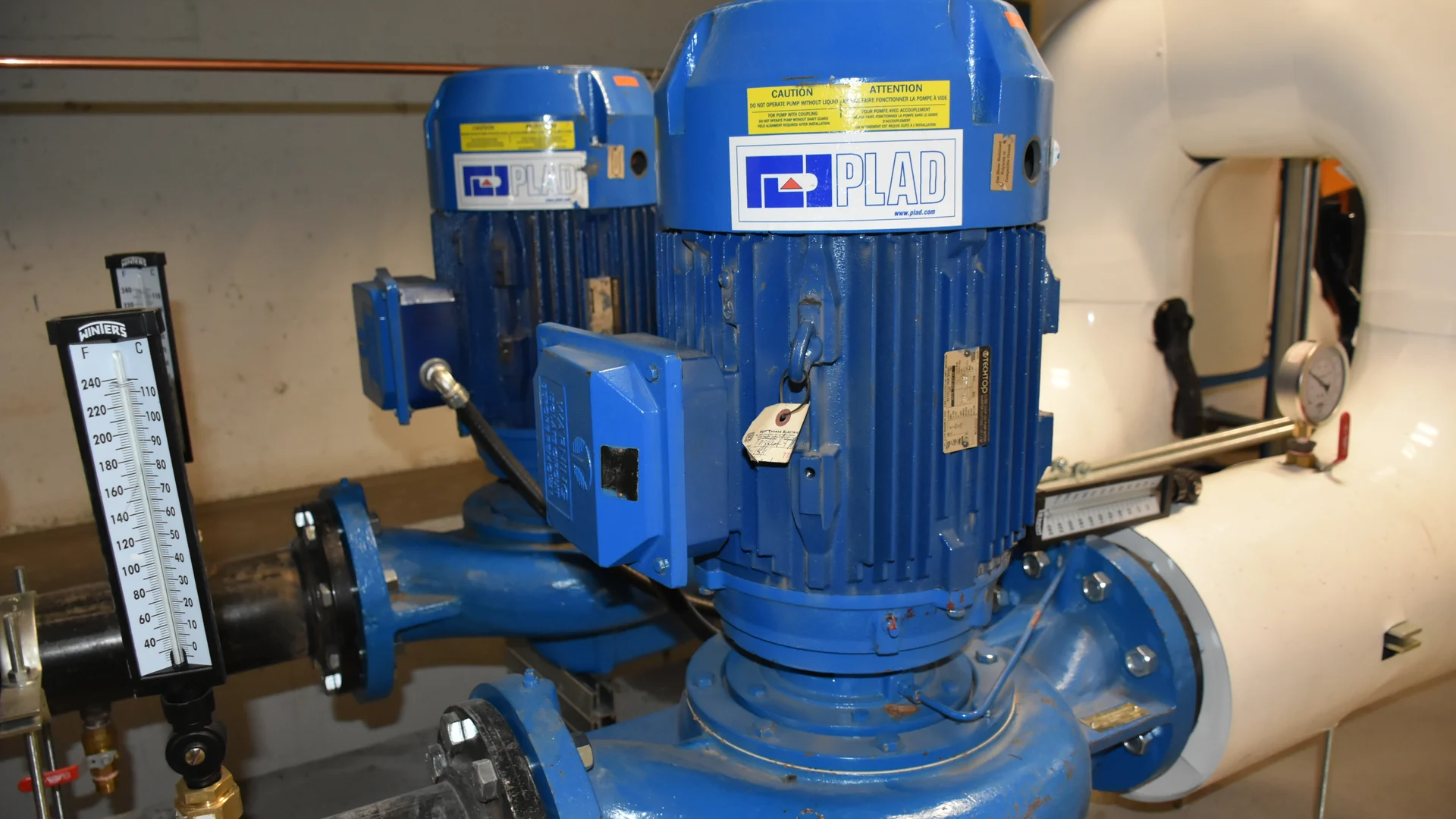
Dispatch checked Pentair's October 1 closing announcement and July 28 transaction terms, and PitchBook's October 2 report as syndicated by Yahoo Finance. The reported A1 ratio and Pentair's adjusted forecast-based ratio are not normalized comparables. No standalone Taco EBITDA was reverse-engineered and no synergy was presented as already achieved. The $320 million transaction and all figures in its worked example are hypothetical. No interviews were conducted. The licensed pump photograph is context, not identified Taco equipment; image derivatives remain CC BY-SA 4.0.
Sources
- Pentair Completes Acquisition of Taco Group Holdings — Pentair plc
- Pentair to Acquire Taco: valuation definitions and strategic rationale — Pentair plc
- KKR's A1 Garage deal raises the valuation bar — PitchBook via Yahoo Finance
- Centrifugal Pump: original photograph and attribution — Wikimedia Commons
- Photo and resized derivatives: Creative Commons Attribution-ShareAlike 4.0 — Creative Commons