
Disclosure
Live Wire Electric is a TradeVulcan customer. TradeVulcan Dispatch is published by TradeVulcan. Operational performance figures attributed to Live Wire Electric were provided by owner Brian McKee and have not been independently audited.
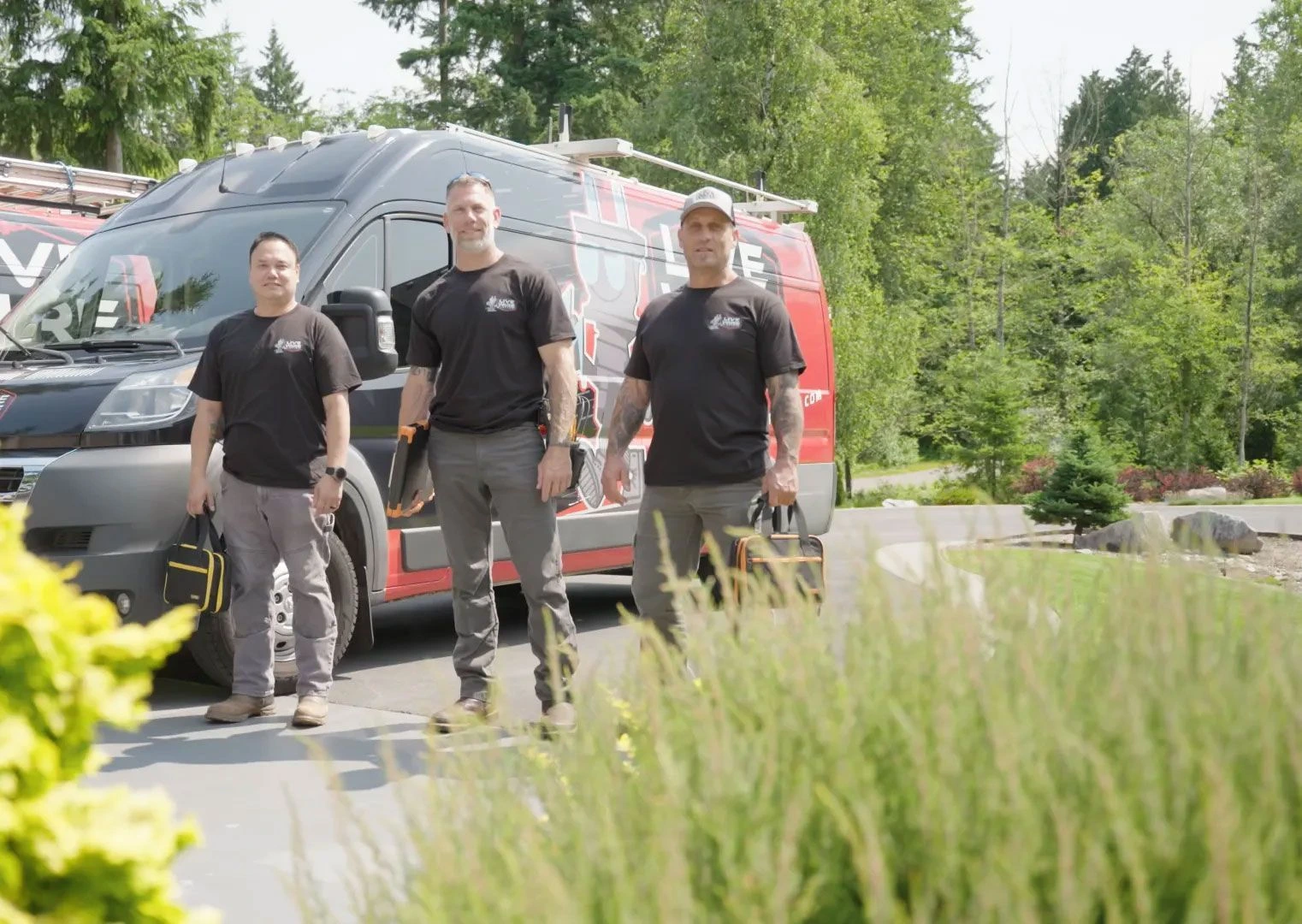
LYNNWOOD, Wash. — Brian McKee has spent more than two decades building an electrical company. Now he believes the business that wins the next decade may have to operate very differently from the one that won the last.
McKee founded Live Wire Electric in 2005. The residential and light-commercial contractor is based in Lynnwood and serves King and Snohomish counties, according to the company's website.[1] McKee says Live Wire is currently doing roughly $2 million in annual revenue and preparing for a period of rapid expansion.
The company is participating in CertainPath's best-practice program and adding coaching as it tries to strengthen its culture and preserve an identity McKee considers strategically important: locally owned, community-oriented and independent of private-equity ownership.
“Every company is a marketing company first that happens to do electrical, or HVAC, or plumbing. To grow a business, you must be adept at marketing, sales and production.”
The old contractor marketing playbook is fragmenting
Five to 10 years ago, McKee remembers Live Wire's customer-acquisition mix as newspaper ads, some radio, Google ads and a large amount of word of mouth. Today he describes a much more fragmented environment: Meta and Facebook advertising, pay-per-click search, social media and lead aggregators such as Angi, Yelp and eLocal.
He calls the new environment “lead arbitrage,” a constant effort to shift spend and attention among channels as pricing, lead quality and platform performance change.
Jobber's 2026 Home Service Trends Report points in the same direction. Referrals and repeat customers remained the most frequently named top lead sources, but Facebook, Google Search, Local Services Ads and lead-generation sites all represented meaningful parts of the mix.[2]
Home-service lead generation is already multi-channel
Share of surveyed home-service businesses naming each channel among their top lead sources.
McKee's response is diversification. He wants a lead source the company can scale up when needed, but he also wants to retarget customers Live Wire has already served and stay connected to the company's own database.
“The easiest customer to sell something to is the one you've already sold something to,” he said. “But more importantly, we value keeping the relationship.”
He has also experienced the downside of relying too heavily on one platform. McKee says Live Wire has seen Local Services Ads perform strongly in one period and dry up in another without an obvious operational change. “You can go from spending $5,000 to $10,000 a month on leads to zero and you didn't change anything,” he said. “That hurts.”
Competing against capital
McKee sees another force reshaping the market: the continued expansion of large, private-equity-backed home-service platforms. His concern is not that those organizations are unsophisticated. It is that they can often deploy marketing capital at a scale a $2 million independent contractor cannot match.
The broader market remains active. Blackstone announced an agreement in February to acquire Champions Group, a residential services platform with more than 1,800 field technicians and 150,000 active members.[4]Reuters later reported that American Residential Services, which generates more than $1.5 billion in annual revenue, was exploring a sale that could value the company above $3.5 billion amid continued private-equity activity in residential services.[5]
McKee's view is that independent operators need a different counterweight. “PE is very smart and they deploy capital,” he said. “At the end of the day, PE-owned companies struggle with reputation and we shine there.” That assessment is McKee's opinion, not a measured finding about private-equity-owned contractors as a group.

The homeowner changed, too
The competition for attention is only half of the change. McKee says homeowners now place more weight on reviews, map visibility and convenience before ever speaking with an electrician.
“If you don't have a lot of reviews, and aren't getting reviews frequently, you lose,” he said. “Map search is huge, and being at the top of the map pack is important. AI search is getting there, and more customers prefer to have the ability to book jobs online or by chat. Much more booking by text versus calling.”
Jobber's report likewise found that response speed and friction matter alongside reputation. It reported that 60% of home-service businesses respond to new leads the same day, 20% respond within an hour, and faster-response systems are associated with higher-performing operators.[2]
The moment AI became operational
McKee does not describe himself as an AI power user. His first exposure was familiar enough: “tapping away on GPT.” But he says he is not particularly technical and prefers AI when it is embedded into a workflow and does useful work without requiring him to become a prompt engineer.
The moment the technology became real for him was automated customer response, including missed-call text-back and follow-up through TradeVulcan.
“Follow-up is such a huge thing. Having it done for you after we've already made a meaningful human connection carries the ball forward and shows our ability to keep great communication with our clients.”
Estimate follow-up was one of Live Wire's biggest weak points. The company wanted sequences of emails and texts to reconnect with customers after providing an estimate, but the old process was manual. “Admittedly, we dropped the ball a lot here,” McKee said. “AI and automation helped us bridge that gap.”
Live Wire reports a sharp increase in Angi booking rate
McKee says faster automated response and follow-up accompanied a rise in the company's Angi booking rate from about 12% to 49%. Dispatch did not independently audit the underlying lead records.
| Metric | Before | Current | Context |
|---|---|---|---|
| Angi booking rate | ~12% | ~49% | Company-reported |
| Yelp / Angi initial response | 5–10 min average | Seconds | Webhook/API-triggered text response |
| Direct web bookings | Almost none | ~70–80/month | Company-reported additional bookings |
| Monthly revenue | Prior-period baseline | >30% higher | Month-to-month comparison; multiple initiatives were underway |
| Review requests | More manual | Automated | McKee says review volume increased |
Source: Brian McKee, Live Wire Electric. Figures have not been independently audited by TradeVulcan Dispatch.
McKee says direct website bookings moved from almost none to roughly 70–80 per month. He also says Yelp and Angi response times fell from a five-to-10-minute average to seconds after Live Wire connected incoming leads to automated text responses through APIs and webhooks.
He reported monthly revenue more than 30% higher than the immediately preceding comparison period. Dispatch is not attributing that increase solely to TradeVulcan or AI: Live Wire was changing multiple parts of its marketing and operating system at the same time, and Dispatch did not audit the company's financial statements.
Interest in contractor AI is ahead of adoption
ServiceTitan's 2026 survey of 1,000 residential contractors found broad belief in AI's efficiency potential, but much lower current adoption.[3]
AI behind the scenes. Humans out front.
The more interesting part of McKee's strategy may be what he does not want AI doing. As Live Wire automates more repetitive operating work, he is simultaneously pushing the company to become more visible and more human.
That means social media, including Facebook, TikTok and YouTube Shorts. McKee wants the company's technicians involved, and he wants to build a personal brand as the owner. “I want customers to know where the buck stops,” he said. “I'm deeply involved in our local company. I can always be reached.”

Live Wire recently commissioned new company photography so customers can see the people they may invite into their homes. McKee says he has participated in several hundred videos. He did not start comfortable on camera and still finds it takes effort to get a take right.
“At the end of the day, I'm an electrician, not an actor,” he said. “But it's necessary to connect.”
He believes polished marketing and authenticity both matter. Too much polish can make a local company feel cold and corporate, he says; too little can undermine competence.
“We need to be human where being human matters.”
Automate the mundane, not the identity
McKee is particularly skeptical of using generative AI as a substitute for reality. He calls synthetic equipment photos, fake customer scenes and generic AI-written content “corny and overplayed” when they are presented as if they reflect the actual company.
“Storytelling is a uniquely human experience and it always should be,” he said. His rule for customer-facing material is that it should originate from the real company, its employees and its customers. If AI participates, he wants it to be additive and context-aware rather than a fabricated identity.
The place contractors may be underestimating AI, he argues, is less glamorous: repetitive operational tasks. Follow-up, lead routing, booking, review requests, some diagnostics support, data entry and eventually backup call handling are the areas he expects to automate more aggressively.
“I think AI is a tool just like a meter is a tool.”
Can cheaper automation level the field?
McKee sees a paradox in the same market pressure that concerns him. Large operators helped normalize sophisticated automation, but AI is lowering the cost of capabilities that smaller contractors historically struggled to afford.
“A few years ago we could not afford this level of automation,” he said. “It was typically reserved exclusively for large, multi-location or PE operations that were north of $10 million in revenue. I think smaller contractors, like myself, can now compete at the same level as the bigger players.”
ServiceTitan's residential survey offers a broader version of that transition: 74% of respondents said they view AI as an efficiency engine, while only about a quarter said they were already using it.[3]That gap leaves substantial room for operational adoption.
McKee does not expect the transition to be anxiety-free. He says Live Wire employees have shown a mixture of excitement, curiosity, skepticism and concern about job replacement. His goal is to use efficiency to create more capacity for the company to grow without discarding the people who made the business valuable.
Becoming “five-mile famous”
McKee's shorthand for the social strategy is “five-mile famous.” The objective is not necessarily to trace every TikTok, Facebook post or YouTube Short directly to a booked electrical call. It is to make Live Wire recognizable in the communities where it already does business.
He expects the payoff to emerge across the entire acquisition mix: more branded searches, more direct and organic calls, stronger conversion and less dependence on buying every interaction.
Google PPC and Local Services Ads will remain important in his view. Meta remains significant. He thinks TikTok is building and YouTube Shorts is underused by contractors. McKee is also watching advertising inside ChatGPT. OpenAI expanded its ChatGPT ads pilot in May with partner buying, a beta self-service Ads Manager, cost-per-click bidding and additional measurement tools.[6]
What changes next
Three years from now, McKee expects backup call handling and routing, follow-up, review requests, lead booking and parts of data entry and financial administration to be substantially more automated.
The humans, in his view, should increasingly occupy the places where humans matter most: the customer's home, the difficult conversation, the diagnosis, the relationship, the community and the story a company tells about itself.
His advice to contractors considering AI is deliberately severe: “Do it now or die slowly, and don't listen to the people who say AI won't help or work. They will be left in the dust.”
Asked what the home-service company that wins the next decade will do differently from the company that won the last one, McKee needed only one word.
“Adapt.”
Methodology
TradeVulcan Dispatch interviewed Live Wire Electric owner Brian McKee in a written Q&A on August 31, 2026. Statements about Live Wire Electric's revenue, booking rates, response times and operating changes are company-reported unless otherwise noted. Dispatch reviewed Live Wire Electric's public website and cited industry and transaction sources for broader context, but did not audit Live Wire Electric's CRM, lead-platform or accounting records. The interview was edited for length, clarity, spelling and punctuation without changing the substance of McKee's answers.
Sources
- [1] About Live Wire Electric — Live Wire Electric
- [2] 2026 Home Service Trends Report — Jobber
- [3] ServiceTitan Report Finds 74% of Residential Contractors See AI as Key to Efficiency — ServiceTitan
- [4] Blackstone Announces Agreement to Acquire Champions Group — Blackstone
- [5] American Residential Services explores $3.5 billion-plus sale, sources say — Reuters
- [6] New ways to buy ChatGPT ads — OpenAI