
Disclosure
TradeVulcan publishes Dispatch and sells contractor software. This independent follow-up is not sponsored by Brookfield, Reliance Worldwide or SharkBite. Product examples are not installation instructions or product endorsements.
There are two prices worth watching in Brookfield's pursuit of SharkBite's parent company. One is the amount a buyer will pay for the business. The other is the installed cost a plumber has to recover on the next service call.
Reliance Worldwide's signed Brookfield agreement allows a go-shop through October 15, 2026: a window to seek competing proposals before the transaction advances. The agreement announced September 16 values the plumbing-products group at approximately US$2.9 billion on an enterprise-value basis.
The approaching deadline makes this a developing transaction story, not a newly announced sale. It also offers a useful moment to separate the financial buyer's economics from the contractor's.
October 15 is not the day ownership changes
The agreement offers US$3.38 in cash per share. RWC can solicit alternative proposals during the go-shop; Brookfield has matching rights. Shareholder, court and regulatory approvals remain among the conditions, and RWC's indicative timetable points to implementation in the first quarter of 2027.
A go-shop is an opportunity to test interest, not evidence that a superior bidder exists. This report does not identify a confirmed competing offer or treat the acquisition as completed.
For contractors, a deadline in the transaction process is not a reason to stockpile fittings or rewrite every estimate. The commercial signals to act on remain actual supplier notices, product availability and the terms of the work being quoted.
A public multiple is not a price for an independent plumbing business
RWC describes the deal as approximately 12.1 times fiscal-2026 adjusted EBITDA on its post-AASB16 basis. That accounting basis matters because lease treatment affects comparison with another business or transaction.
More fundamentally, buying a multinational product platform is not the same transaction as buying a local service company. The assets, reinvestment requirements, customer relationships and operating risks differ. Lifting the manufacturer's multiple into a contractor valuation conversation skips those differences.
The better question is what makes each company hard to replace. For a supplier, that may be a product line a channel relies on. For a plumbing contractor, it may be a dependable team, a repeat-customer base or a service process that competitors struggle to match. Those are hypotheses to demonstrate with operating evidence, not premiums to assume.
The acquisition premium does not mean the supply chain is having an easy year
Reuters reported that RWC's fiscal-2026 Americas sales fell 4% and adjusted operating earnings declined more than 11%, with tariffs, softer volumes and higher input costs weighing on performance.
That backdrop is important. A buyer can see long-term value in a company while its current operations are under pressure. The purchase price does not establish that the manufacturer has unlimited room to absorb every cost increase, or that new ownership has decided to pass increases to contractors.
At the supply counter, ownership is only one variable. A change in the price of a part may reflect its materials, sourcing, freight, demand or the distributor's own terms. Treating every future increase as a private-equity surcharge would replace an investigation with an assumption.
The relevant unit is the completed repair, not the fitting
SharkBite's current U.S. product site spans push-to-connect products, PEX pipe and multiple PEX connection systems. That is a reminder that a contractor is choosing a method and workflow, not merely comparing two price stickers.
An acceptable comparison begins with products approved for the actual application and installed according to the applicable requirements and manufacturer instructions. After that, examine purchase price, preparation, installation time, tool requirements, availability and expected service or rework cost.
The lowest-priced component is not necessarily the lowest-cost completed repair. Equally, a claim about faster installation is not a substitute for measuring what the company's own technicians actually achieve. Neither conclusion establishes that one connection method is best for every job.
SharkBite: U.S. product families and installation resources ↗
A hypothetical eight minutes can change the material-cost argument
Suppose an approved alternative costs $8 more and saves eight minutes on an otherwise equivalent task. At a hypothetical loaded labor cost of $90 an hour, those minutes represent $12 of labor capacity. Before any other differences, the time value exceeds the material premium by $4.
This is an illustration, not a SharkBite performance claim. Saved time is not automatically cash saved or another billable job. The crew might still be paid for the same shift, and the freed minutes might not translate into usable capacity. Additional preparation, tooling or callbacks could also change the result.
The point is to measure the whole task. A purchasing team rewarded only for lower unit prices can make a decision that looks successful in procurement and expensive in the field.
Illustration only: compare a material premium with labor capacity
| Input or calculation | Illustrative amount |
|---|---|
| Additional material cost | $8 |
| Time reduction assumed | 8 minutes |
| Loaded labor cost assumed | $90 per hour |
| Labor-capacity value: 8 / 60 × $90 | $12 |
| Difference before all other factors | $4 |
The quieter margin risk is a price book that remembers last month's invoice
A supplier increase can hurt twice: once when the company buys the product and again when an old estimating assumption keeps charging as though nothing changed. This is an operating risk to check, not a pricing change announced with the Brookfield agreement.
Take another hypothetical example. A $2 increase across 1,500 units represents $3,000 of additional purchasing cost. Whether that becomes a margin reduction depends on actual usage, inventory timing, contract terms and selling prices. The acquisition headline does not answer any of those questions.
A useful purchasing review therefore joins accounts-payable data to job-costing data. Identify the frequently used items, compare the latest actual cost with the price-book assumption and record who owns the correction. Small items can deserve more attention than a large piece of equipment bought only occasionally.
Ask the distributor for evidence, not a prediction about Brookfield
The next supplier conversation can be specific. What changed on the latest invoice? Is the difference a manufacturer adjustment, freight, a lost discount or a substitution? How long does a quoted price remain valid, and which approved alternatives are genuinely available?
Then review continuity. Confirm the route for technical support and warranty questions, document the parts that would stop a scheduled job and avoid relying on an untested substitute simply because it is in stock.
None of this requires a forecast that Brookfield will raise prices, cut quality or change distribution. Those outcomes have not been established by the agreement. The purpose is to keep an ownership story from distracting the business from information it can verify and act on today.
Wall Street is testing the company price. Contractors should test the job cost.
The October 15 go-shop deadline will mark a stage in RWC's sale process, not the end of every approval or the beginning of an announced pricing reset. For plumbers, the durable lesson is to connect purchasing, field productivity and estimating. A multibillion-dollar deal matters most when the operator can explain how the products in the truck affect the margin on the finished job.
Methodology
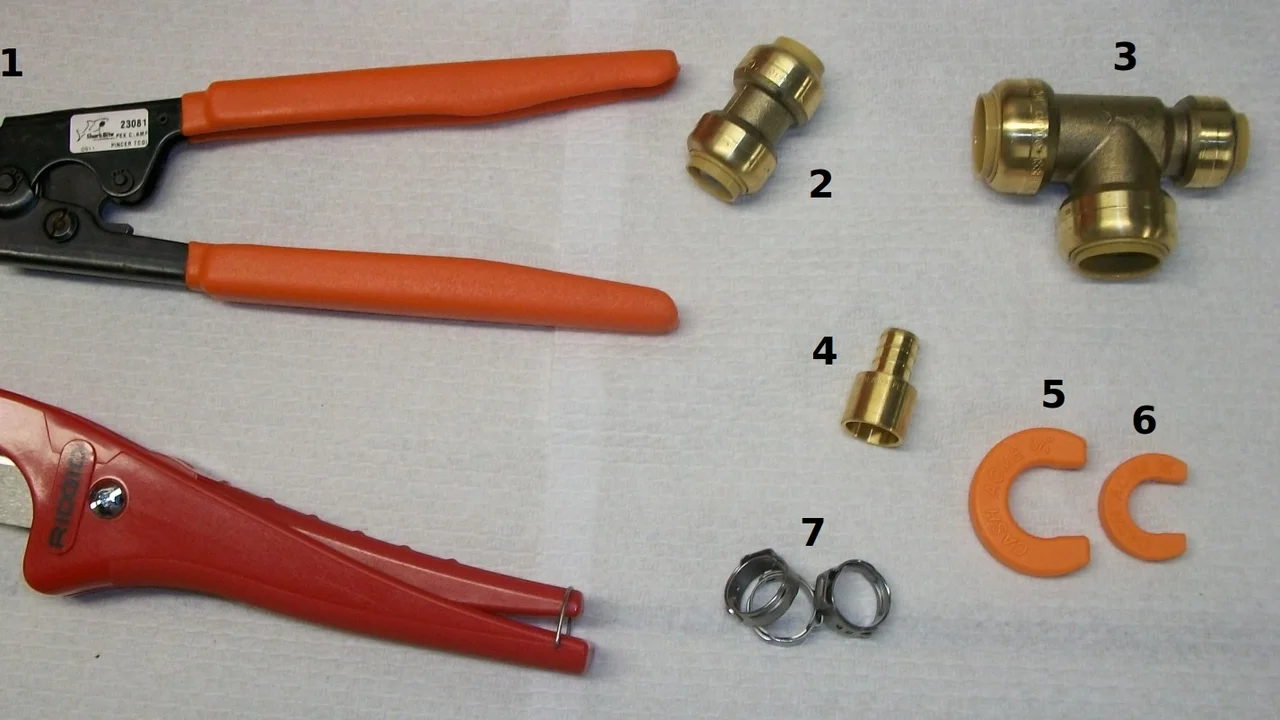
This is an October deadline follow-up to Dispatch's September coverage, not a newly announced transaction. Dispatch checked RWC's September 16 definitive-agreement announcement, Reuters' September 16 report and SharkBite's current U.S. product site. The US$2.9 billion enterprise value and 12.1x multiple retain RWC's post-AASB16 basis. October 15 is the disclosed go-shop deadline, not closing. No competing offer, completed acquisition or acquisition-related product-price change is asserted. Cost and labor calculations are hypothetical, not product testing or installation advice. No interviews were conducted. The archival tools photograph includes identified SharkBite disconnect clips; other items are not all attributed to RWC.
Sources
- RWC enters a Scheme Implementation Deed with Brookfield — Reliance Worldwide Corporation
- Reliance Worldwide agrees to Brookfield's $2.9 billion buyout — Reuters
- SharkBite U.S. product families and installation resources — SharkBite / RWC
- PEX installation tools and fittings: original photograph — Wikimedia Commons
- Photograph and resized derivatives: CC BY-SA 3.0 — Creative Commons