
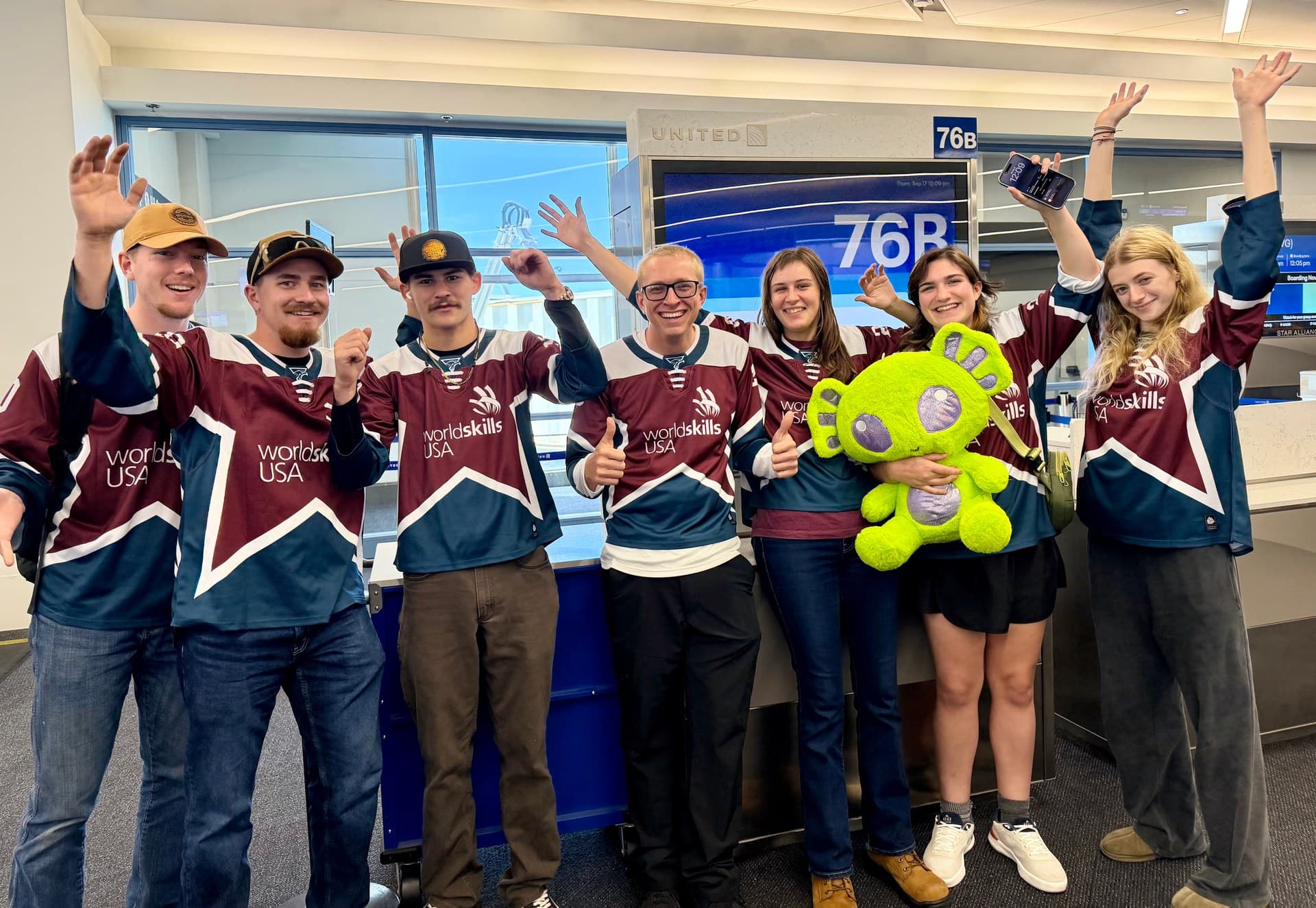
A plumbing apprentice does not usually get a send-off at an airport in a Team USA jersey. Charles Goede is getting a different kind of September.
The 20-year-old Connecticut apprentice will represent the United States in Plumbing and Heating at WorldSkills Shanghai 2026. SkillsUSA’s newly published departure photographs show members of the American team together in Los Angeles on September 17, their workwear replaced by matching jerseys and their attention turning toward the world stage.[1][7]
The opening ceremony is September 22. Competition runs September 23–26, followed by the closing ceremony September 27. Often called the “Olympics of the trades,” WorldSkills is an international skills championship, not the Olympic Games. The contest floor is Shanghai’s National Exhibition and Convention Center.[2]
For the people who install, repair and maintain the systems inside our buildings, this is a chance to watch something familiar receive unfamiliar treatment: skilled work as a medal event.
And for a young person wondering whether a trade can be something to aspire to—not merely something to fall back on—Goede offers a compelling answer.
A national silver was not the finish line
Goede graduated from Ella T. Grasso Technical High School in Groton, Connecticut. In 2024, he won his state’s SkillsUSA plumbing championship and finished second nationally. SkillsUSA announced his selection for Shanghai in September 2025, making him the first competitor named to the 2026 U.S. team.[3]
Even the invitation could have slipped past him. In a July profile for IAPMO’s Official magazine, writer Mike Flenniken reported that it reached an inactive school email account. A former adviser, copied on the message, forwarded it to Goede.[4]
It is a small detail with a larger meaning. The path from classroom to international competition did not depend only on one student being talented. It also depended on somebody staying connected after graduation.
There is a useful lesson in the silver medal, too. Second place can look like the end when the contest is over. In a developing career, it can be evidence of how much further someone could go with another opportunity, another instructor and more time to practice.
“Getting a chance to represent the United States on the world stage in this competition is amazing.”

One competitor. A lot of people in his corner.
The support is tangible. SkillsUSA’s selection announcement identified a coalition including UA Local 777’s training program, the PHCC Educational Foundation and IAPMO. It named plumbing instructor Robert Hahn and contractor Larry Shoemaker among the technical trainers, with the Foundation providing financial and logistical backing.[3]
Shoemaker, owner of Deluxe Plumbing & Heating, is listed as the U.S. Plumbing and Heating expert in the September delegation announcement. DEWALT separately announced tools and resources for Goede and U.S. carpentry competitor Tristan Coates in June.[1][5]
IAPMO’s July account described Goede as a fourth-year UA Local 777 apprentice, preparing between field work and the union hall. His training with Local 777 coordinator Vinnie Valente included tube bending, metric measurements and unfamiliar fixtures and joining methods—not just more repetitions of work he already knew.[4]
That distinction matters. Getting better is not always a matter of working faster at the familiar task. Sometimes it means slowing down long enough to learn a different one.
An employer can supply a tool. A mentor can show how to use it. Development needs both—and room for a learner to ask the question before a mistake becomes part of the installation.
What does world-class plumbing actually mean?
The 2026 WorldSkills occupational standard provides a more useful answer than “being good with your hands.” Its scope spans interpreting drawings, planning materials, installing systems, checking performance and handing completed work over to a customer. Knowledge is primarily assessed through performance.[6]
Installation carries the largest weighting, at 48%. But the standard also explicitly values organization, communication, design, commissioning and repair. The six categories below describe the published standard—not a leaked Shanghai test project or a promise that every listed task will appear in the competition.[6]
That is a picture of a thinking trade. A finished assembly matters, but so do the decisions that produced it and the checks that establish whether it works.
The distinction should be familiar to anyone who has handed a job to an apprentice. Following a sequence is one milestone. Understanding why that sequence matters, spotting an unexpected condition and knowing when to seek help are further milestones. A clean-looking installation is not, by itself, proof of a safe or properly commissioned system.
| Skill area | Weight |
|---|---|
| Organizing and managing the work | 6% |
| Communicating with others | 6% |
| Designing and adapting systems | 15% |
| Installing pipes, fixtures and equipment | 48% |
| Connection, testing and commissioning | 15% |
| Maintenance and repair decisions | 10% |
The American team has more than one story worth following
SkillsUSA’s September announcement lists nine U.S. competitors across eight skills, with two people entered in Mechatronics. The organizer estimates a worldwide field of roughly 1,400 competitors from 73 countries and regions, competing in 64 skills. Those are pre-event estimates, not a final attendance count.[1]
Goede’s teammates include 22-year-old Florida carpenter and business owner Tristan Coates. The roster also includes Mikala Sposito of Michigan in Welding and Alexis Squyres of Pennsylvania in CNC Milling—the first women to represent the United States in their respective WorldSkills skill competitions, according to SkillsUSA.[1]
They are not interchangeable examples of a workforce pipeline. They are people with different specialties, different paths and names a student can look up.
That makes the competition useful beyond the medals. A teenager who has never met a professional welder can see someone close to their age compete at it. A carpentry student can connect the craft to business ownership. A plumbing apprentice can see that a school workshop is not necessarily the limit of the opportunity.
What a local contractor can take from the world stage
The practical response does not have to be a grand new training program. Start by making good work more visible inside the company.
At the next team meeting, put a completed job on the screen—with the customer’s permission and identifying details removed where needed. Ask the technician to explain a difficult decision, not just display the finished result. What condition changed the plan? What did the apprentice notice? What check caught a problem before handover?
That turns recognition into teaching. It also gives a newer employee a picture of what progress looks like beyond being assigned another task.
Then give the training a place on the calendar. A supervised practice assembly, a drawing-reading exercise or a review of manufacturer instructions can have a clear learning goal and a debrief. These are suggested shop practices, not claims that a particular company or competitor follows them.
Competition can make those exercises engaging. It should never make speed an excuse for an unsafe shortcut or an out-of-code installation. Field work still has to meet the applicable requirements, and apprentices still need the supervision their work calls for.
Finally, keep the connection to the local school or apprenticeship program alive. Offer a thoughtful jobsite visit, participate in an instructor’s industry discussion or recognize a student’s achievement. An employer does not have to send somebody to Shanghai to help a young tradesperson believe that their work has a future.
The career continues after the medals
Nobody has earned a Shanghai medal yet. The competition has not begun, and the right way to follow Goede is as a competitor with an opportunity—not a result already written.
For the rest of the industry, that is enough reason to pay attention. Before the podium, there is already an achievement worth recognizing: a young plumber has put his work forward to be measured against an international field.
The most grounded part of the story may be what he plans to do afterward. Goede described it in IAPMO’s July profile:[4]
“Beyond the competition, once those wheels touch down on the runway, it’s full steam ahead with my plumbing and pipefitting career.”
For a few days, the trade gets a world stage. Then it gets its plumber back.