
Disclosure
TradeVulcan Dispatch is published by TradeVulcan, a contractor-software company. This report explains public federal documents and their operational implications; project approvals remain with the applicable authorities.
Tuesday's commercial water-heater deadline comes with a distinction that can easily disappear between a supplier email and a customer's estimate: the federal efficiency standards and the federal enforcement policy are not the same thing.
October 6, 2026 is the manufacturing-compliance date for amended Department of Energy standards covering specified commercial water-heating equipment. The rule itself became effective December 5, 2023. This is the end of its transition period, not a newly issued regulation.
DOE has also published a separate, one-year civil-penalty enforcement policy. That gives the market a second document to read—not a reason to throw away the first.
DOE: commercial water-heating standards and compliance date ↗DOE: commercial water-heater enforcement policy ↗
The headline efficiency numbers are 95% and 96%
For the commercial categories in Table 1 of 10 CFR 431.110, gas-fired storage and storage-type instantaneous water heaters move from an 80% thermal-efficiency minimum to 95%. Gas-fired instantaneous water heaters and hot-water supply boilers move from 80% to 96%. These levels generally mean condensing equipment.
Residential-duty commercial gas-fired storage water heaters are handled separately, with uniform energy factor requirements based on draw pattern and volume. They should not be casually folded into a blanket claim that every gas tank now has the same 95% rating. Storage equipment also has standby-loss requirements.
The practical starting point is the manufacturer's equipment classification and certification information—not whether someone calls the installation residential or commercial in conversation.
10 CFR 431.110: equipment classes, efficiency tables and manufacture dates ↗DOE final rule: amended standards and condensing technology ↗
Three dates to keep separate
| Date | What it means |
|---|---|
| December 5, 2023 | The final rule became effective |
| October 6, 2026 | Amended standards apply to covered equipment manufactured on or after this date |
| October 6, 2027 | End date stated in DOE's current enforcement policy; the covered manufacture window ends before this date |
What DOE actually paused
In its May 5 statement, DOE says it will not seek civil penalties for violations of the amended efficiency standards and related certification requirements for the listed gas-fired equipment manufactured on or after October 6, 2026 but before October 6, 2027. The list includes storage, storage-type instantaneous, instantaneous, hot-water supply boilers and residential-duty commercial gas-fired storage equipment.
The statement cited litigation-related uncertainty when it was issued. It also says it does not create or remove rights or duties, does not change other parts of the underlying law, and can be modified or rescinded. It is an enforcement policy, not a repeal or a rewritten compliance date.
That is narrower than saying any water heater can be installed anywhere for another year. A federal civil-penalty decision is not a local permit, an equipment listing or a manufacturer's installation instruction.
DOE clarified policy: covered equipment, manufacture window and limitations ↗
Tuesday is a factory cutoff, not an order to remove working tanks
The amended standards are tied to when equipment is manufactured. They do not order a building owner to remove a functioning water heater on Tuesday. Nor does an installation date, by itself, tell a contractor which manufacturing standard applied to an older unit in distributor inventory.
For each proposed replacement, obtain the model, equipment class and manufacture date, then have the supplier or manufacturer confirm the relevant compliance information. Keep that confirmation with the equipment submittal and job record. For units made during the enforcement-policy window, distinguish the supplier's reliance on that policy from a claim that the product meets the amended efficiency standard.
Do not turn a stockroom conversation into a blanket legal promise. Check the equipment and the project. The same discipline helps an estimator avoid selling a model that a distributor has listed but cannot actually deliver.
DOE: manufacturing-based commercial equipment standards ↗CFR: standards differentiated by manufacture date ↗
The replacement quote has to include the room around the tank
DOE's rulemaking examined condensate disposal, vent replacement, electrical access and difficult replacement locations as installation-cost issues. Those are not details to discover after a customer accepts an equipment-only price.
Before pricing a condensing conversion, have the qualified installer assess the permitted vent route and materials, combustion-air arrangements, condensate drainage and any required treatment, power supply, service clearances and access for moving the equipment. Use the selected model's instructions and local requirements. Do not assume a vent or drain can be reused because it served the old appliance.
The estimator's deliverable should be a complete scope: what stays, what changes, which trade performs each part and what remains subject to verification. Where a site condition is unresolved, identify it before committing to a fixed installation promise rather than burying it in a generic change-order clause.
Final rule, Section IV.F.2: installation, venting, condensate and access considerations ↗
For a business customer, the outage plan belongs in the proposal
Ask the property manager what actually happens when hot water is unavailable. Which operations need to continue, who can authorize a shutdown, and what work can be completed before the old equipment is disconnected?
Then build the schedule around a confirmed equipment delivery, the required crew and any inspection or commissioning steps. Where temporary service or a staged replacement is proposed, have it designed and approved for the application. Do not promise an improvised workaround from the sales desk.
A useful proposal separates the equipment and installation price from optional work and describes the expected service interruption. That lets the customer compare two contractors on a completed project, not on two tank prices with different amounts of missing labor.
Higher efficiency is not a ready-made savings guarantee
A thermal-efficiency rating is not the percentage a customer's entire gas bill will fall. Before presenting payback, identify hot-water use, operating hours, fuel costs, the existing system's condition and the full installed price difference. Separate a documented estimate from a generic sales calculator.
The operating opportunity for a contractor is to make the comparison understandable: repair where appropriate, a properly scoped replacement, expected maintenance and the assumptions behind any energy calculation. A financing payment should not obscure the installed cost or substitute for an explanation of the work.
Rheem's commercial water-heating page is already directing customers to DOE information about the October 6 standards. Use current manufacturer materials as part of the discussion, but ask for model-specific answers when ordering rather than treating a general product page as a compliance certificate.
Rheem: current commercial-water-heating standards notice and support resources ↗
The Monday-morning move: align purchasing, estimating and the field
Give the team one current equipment-transition reference. Require supplier confirmation before promising a model. Scope venting, drainage, power and downtime before selling the installation. Keep the October 6 manufacturing deadline separate from DOE's limited enforcement policy. The contractor who can explain those distinctions clearly is better positioned to deliver the job without a preventable surprise.
Methodology
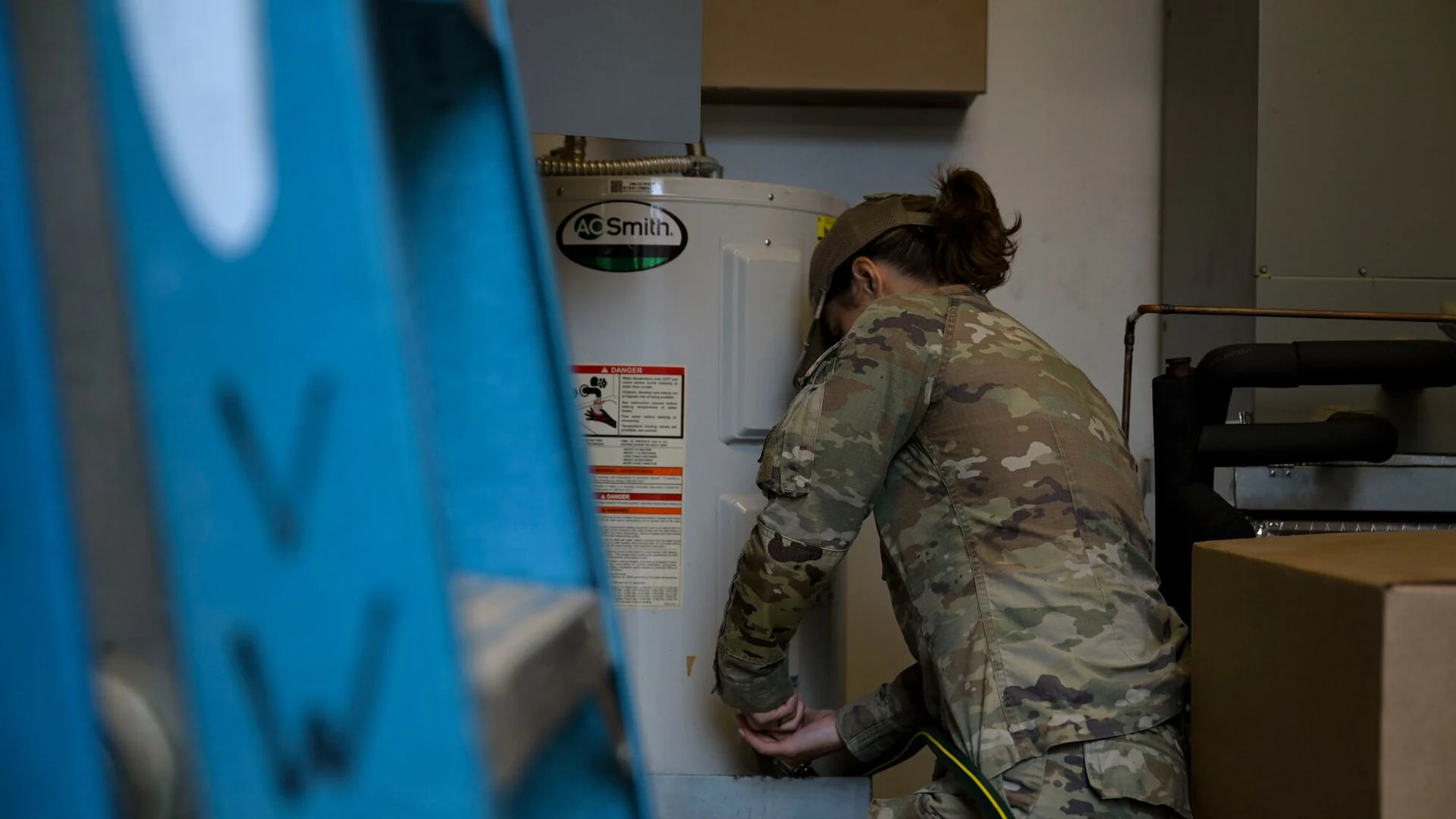
Status checked October 4, 2026 against DOE's current equipment page, the 2023 final rule, 10 CFR 431.110 and the clarified May 5, 2026 enforcement statement. The report distinguishes the rule's effective date, manufacturing-compliance date and enforcement discretion. It does not assume that litigation mentioned in the May statement remains in the same procedural posture today. Project recommendations are Dispatch analysis; no interviews or product compliance inspections were conducted. The photo is archival water-heater service context, not a representation of a compliant 2026 commercial model. The appearance of U.S. Department of War (DoW) visual information does not imply or constitute DoW endorsement.
Sources
- Commercial Water Heating Equipment: current DOE standards — U.S. Department of Energy
- Commercial Water Heater Enforcement Policy — U.S. Department of Energy
- Enforcement Policy Statement: Commercial Water Heaters, clarified May 5, 2026 — U.S. Department of Energy
- 88 FR 69686: Energy Conservation Standards for Commercial Water Heating Equipment — Federal Register / U.S. Department of Energy
- 10 CFR 431.110: Energy conservation standards and their effective dates — Legal Information Institute / Code of Federal Regulations
- Commercial Water Heating: October 6 standards notice — Rheem Manufacturing Company
- Plumbers applying pressure: original water-heater service photograph and credit — U.S. Air Force / Hurlburt Field
- Federal visual-information copyright and editorial-use conditions — Defense Visual Information Distribution Service