
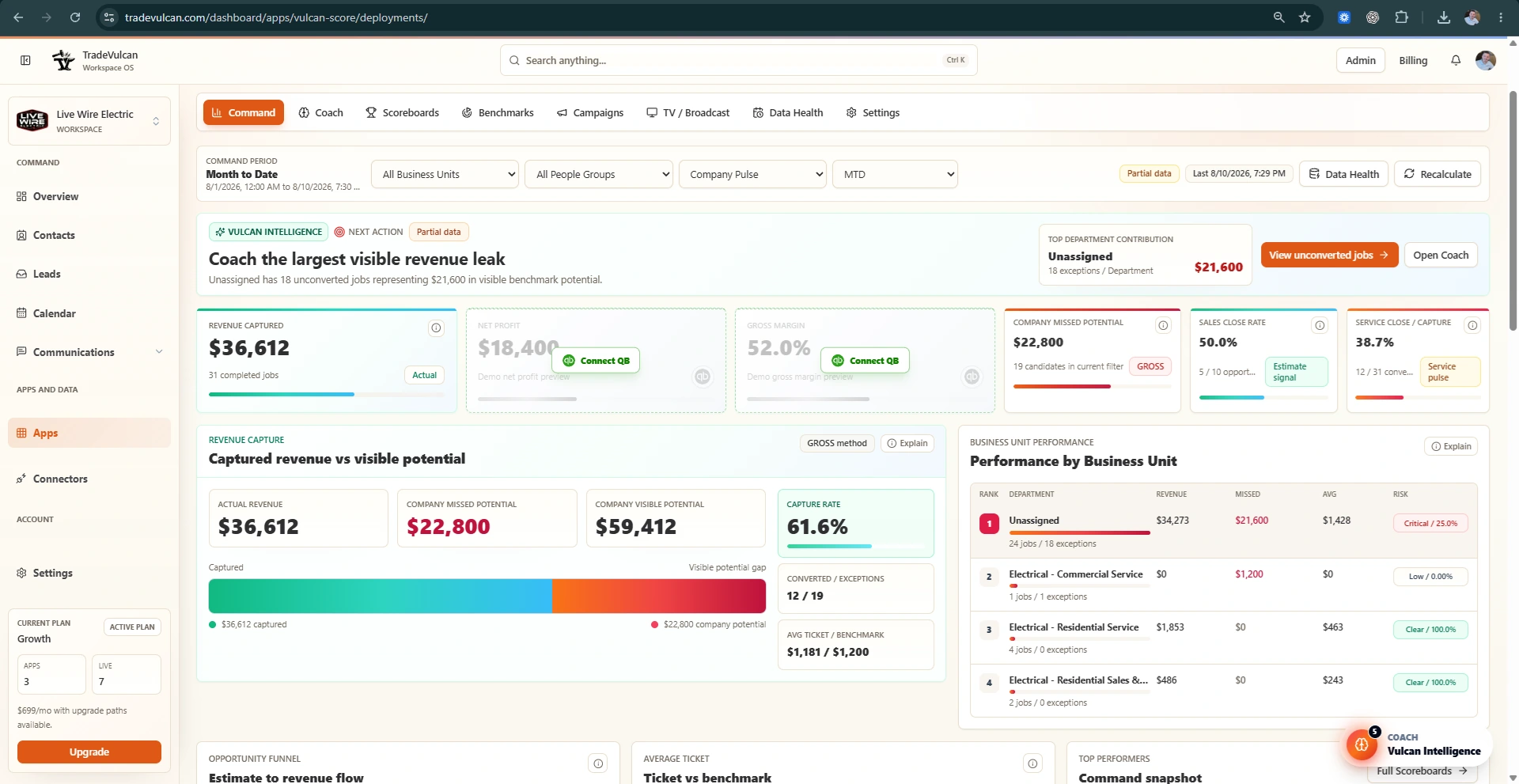
Team engagement in Vulcan Score
Vulcan Score can be used as a scoreboard, recognition engine, contest hub, and rewards system. The key is to use the right KPI for the right purpose. Coaching can happen earlier. Public contests and rewards require cleaner data and clearer rules.
Scoreboards
Scoreboards show leaderboards, scorecards, people performance, team performance, and department ranking. Use Scoreboards to make performance visible without turning every number into a payout.
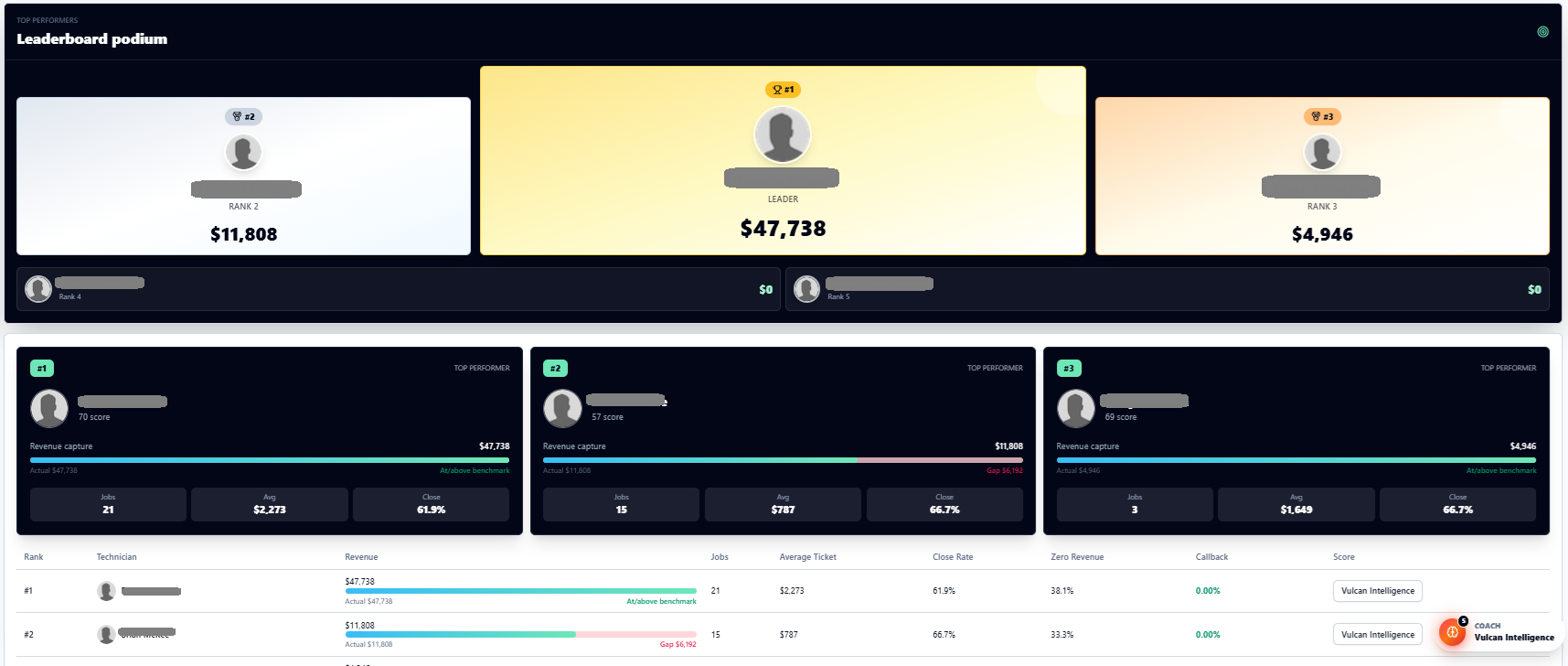
- Use technician revenue, jobs, average ticket, close rate, and Vulcan Score for field teams.
- Use booking rate, calls handled, abandoned calls, and source performance for CSR / Dispatch when call facts are available.
- Use department performance when Business Units and Job Types are mapped well.
Campaigns
Campaigns are behavior-change workflows. They can include contests, goals, recognition, spiffs, and rewards. Use campaigns when the team needs focus, not just visibility.
Contests
Contests work best when the metric is easy to understand, source-safe, and hard to game. Good contest candidates include completed revenue, average ticket, conversion, memberships, calls booked, and service-specific goals when the underlying data is trusted.
Rewards
Rewards should use the strictest data safety. Do not reward against a KPI that is missing source facts, missing attribution, too easy, or not aligned to the team's controllable behavior.
Reward safety checklist
- The formula is clear and documented.
- The source facts are available and current.
- The person or team attribution is reliable.
- The target is not below recent performance or a built-in recommendation.
- The KPI cannot be easily gamed by skipping important work.
- Edge cases are documented, including warranty, callbacks, no-charge, financing, cancellations, and returns.
Recognition without payout
Use recognition for momentum even when a KPI is not reward-safe. A manager can recognize a good call, a strong estimate follow-up, a clean install closeout, or an improved average ticket without tying it to automatic economics.
Best practice
Start with coaching, then goals, then contests, then rewards. Each step needs more confidence than the one before it.