
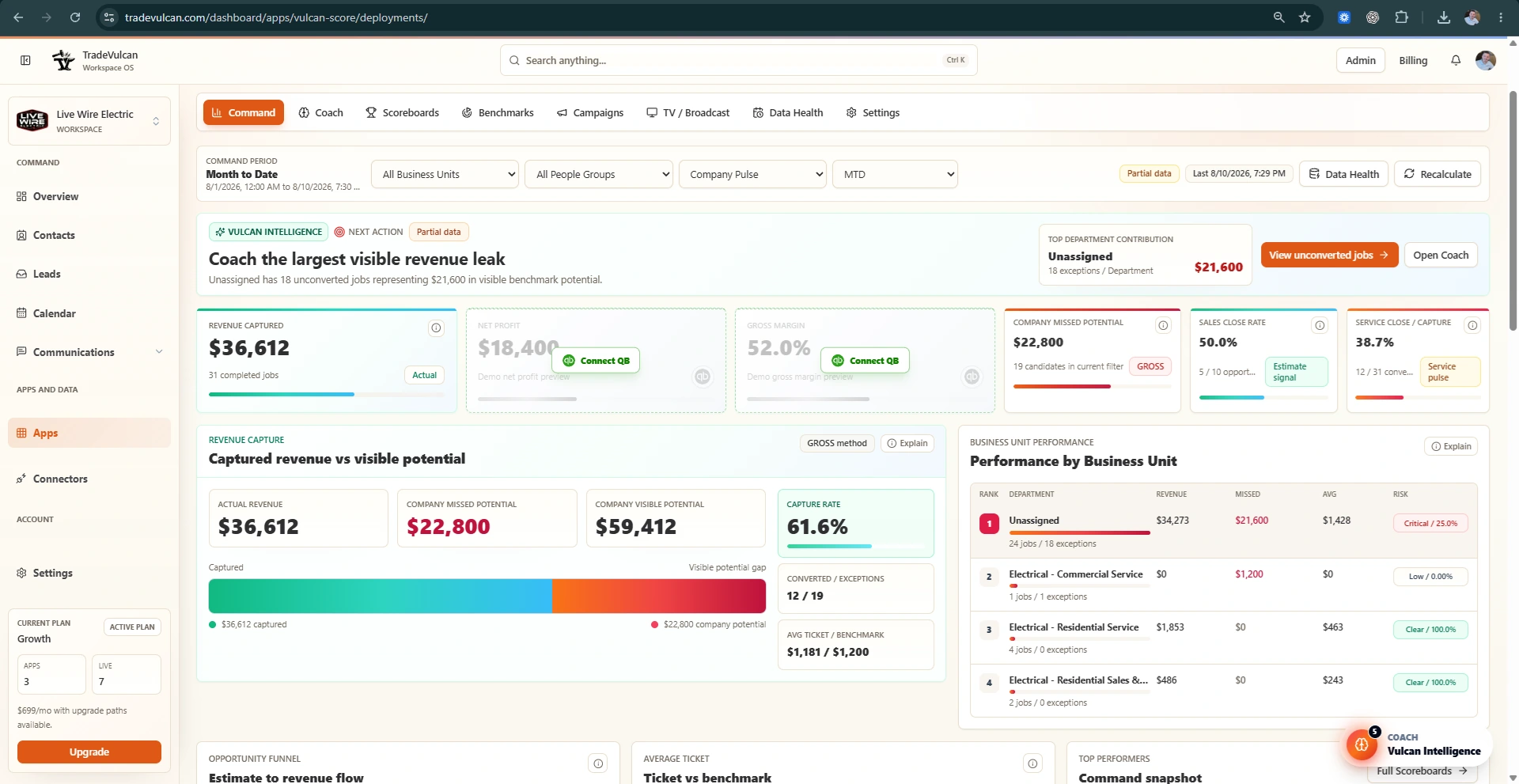
What Data Health is for
Data Health explains whether Vulcan Score has the source facts it needs to calculate trustworthy KPIs. It is the manager-readable version of connector readiness, sync logs, domain support, source counts, and data quality.
Use Data Health before coaching a number that looks surprising, before launching contests or rewards, after connecting a new source, and when a sync is partial, stale, failed, or waiting for a domain.
Data states
| Status | Meaning | What to do |
|---|---|---|
| Ready | The key source facts for the current view are available. | Use for coaching, then review safety before goals, contests, or rewards. |
| Partial | Some source domains are missing or unsupported, but usable facts exist. | Coach supported KPIs and avoid unsupported ones. |
| Syncing | A sync is running. The app may use the last completed snapshot. | Wait for completion if you need the newest data. |
| Stale | The latest completed data is too old for confident daily action. | Run sync or check connector readiness. |
| Connector issue | The source could not be reached or the scope is missing. | Open connector settings or Data Health details. |
| Unsupported | The current connector does not provide the source facts for that KPI. | Use a different source or treat the KPI as unavailable. |
What to verify by data domain
- Jobs: completed date, revenue, technician, Business Unit, and Job Type coverage.
- Estimates: status, sold/open value, presented date, job linkage, and owner attribution.
- Invoices: invoice totals, payments, revenue rows, and accounting alignment.
- Calls: inbound/outbound direction, booked outcome, abandoned or excused status, agent attribution, and campaign/source.
- QuickBooks: revenue, COGS, expenses, Classes, gross margin, net profit, and P&L period.
- People: active technicians, CSRs, salespeople, groups, and assignment coverage.
What "partial data" means
Partial data does not always mean Command is unusable. For example, jobs and revenue may be strong enough for service coaching while call facts or review facts are unavailable. Vulcan Intelligence should treat partial data as a caution, not an automatic blocker, unless the missing domain is required for that KPI.
Source-safety examples
| KPI | Safe when | Not safe when |
|---|---|---|
| Average ticket | Completed jobs and revenue are synced and mapped. | Revenue is missing, many jobs are zero-revenue, or job types are mixed. |
| Sales close rate | Estimate status, sold/open signals, and salesperson attribution exist. | Jobs exist but estimates are empty or status is missing. |
| CSR booking rate | Call facts include booking outcomes and agent/source attribution. | Calls are unavailable or most calls are unassigned. |
| Gross margin | QuickBooks or job costing has trusted revenue and cost rows. | COGS, Classes, or cost categories are incomplete. |
When to trust a number for rewards
Rewards require higher trust than coaching. A KPI should be formula-clear, source-backed, mapped to the right person or department, hard to game, and reviewed for edge cases. If Data Health says directional, partial, or setup needed, keep the KPI in coaching mode until cleanup is complete.