
Disclosure
TradeVulcan develops and sells AI-enabled workflow software for home service contractors. Transaction facts and market data in this report are based on the cited third-party sources. The TradeVulcan Perspective section is explicitly labeled as company perspective, not an independently measured industry finding.
Scope and status note
This report is current through August 29, 2026.
The headline transaction statistics come from Capstone Partners' July 27 HVAC Services M&A update. Those figures cover Capstone's HVAC services data set, not every home service trade. The deal examples below extend into plumbing, electrical, roofing, restoration and distribution.
TradeVulcan Dispatch distinguishes completed acquisitions from signed but pending transactions and nonbinding proposals. Financial terms are described as reported when the companies did not publicly disclose them.
The market did not stop consolidating—it became more selective
Private equity has not left home services. The evidence points to a more disciplined phase of consolidation.
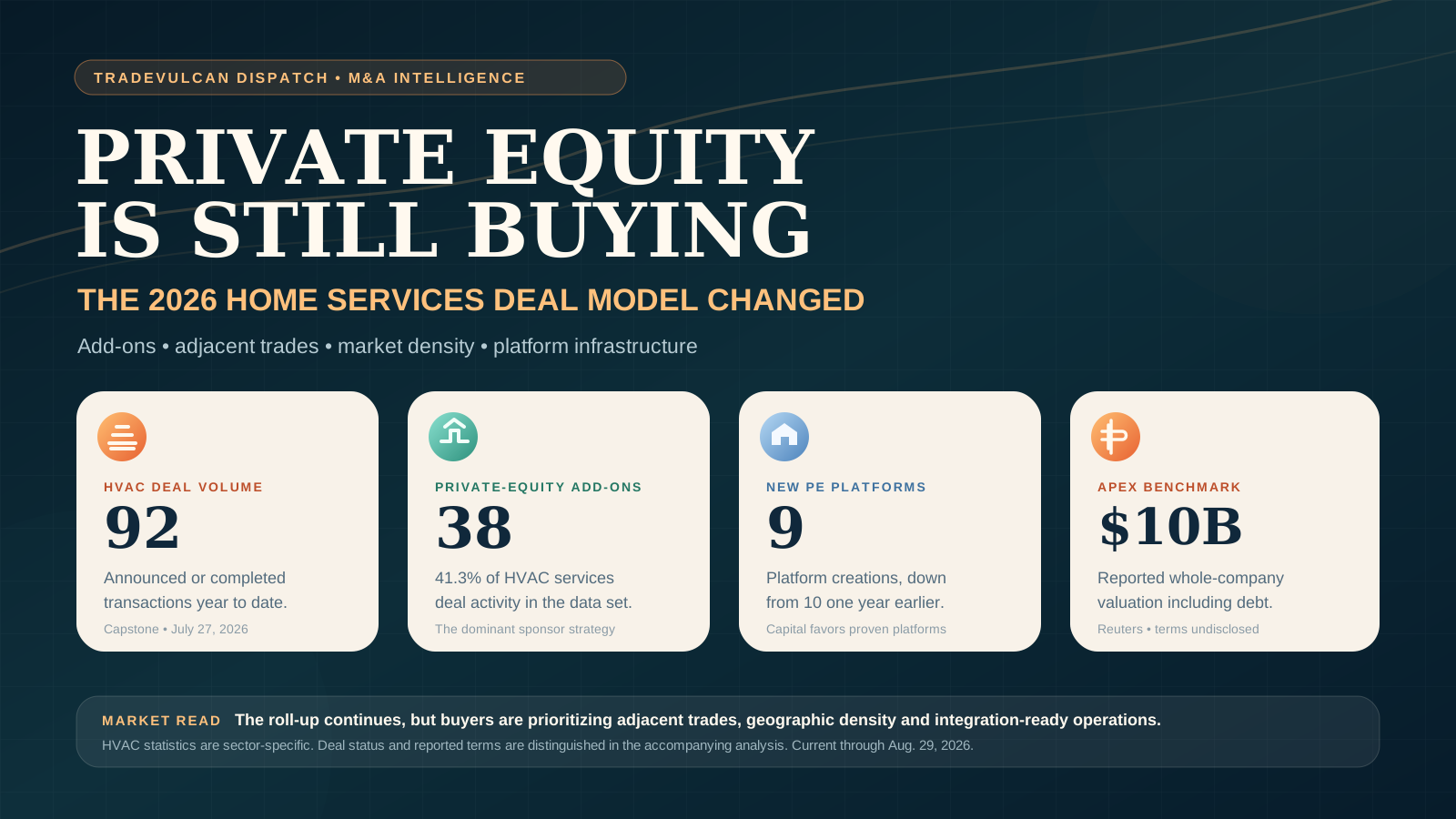
Capstone Partners counted 92 announced or completed HVAC services transactions year to date through its July update, only 4.2% below the comparable 2025 period. Financial-sponsor activity edged up to 47 transactions from 46. The important shift was inside that sponsor total: 38 transactions were private-equity add-ons, representing 41.3% of all HVAC services deal activity, while new platform creation fell from 10 to nine.
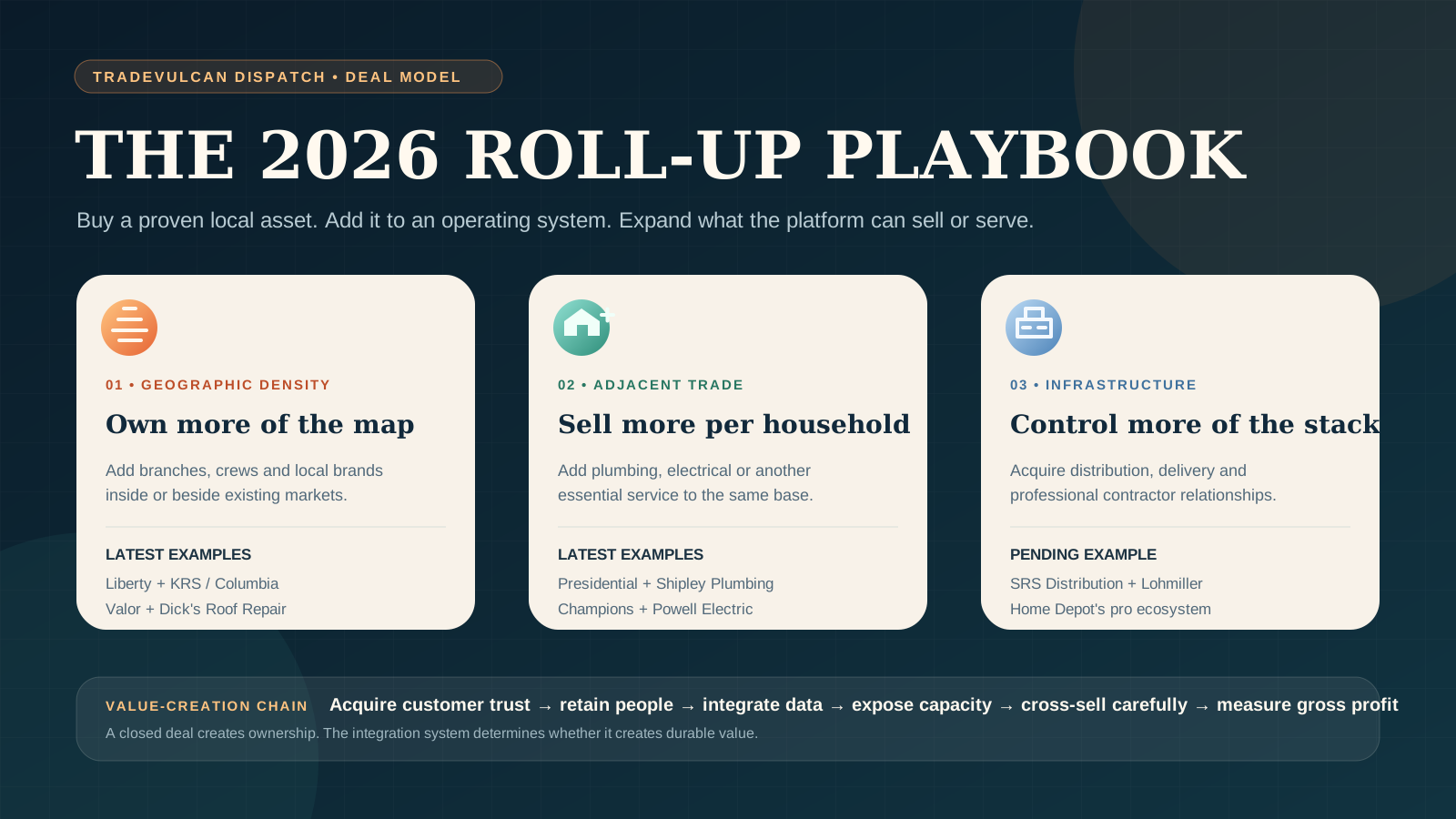
Late-August announcements reinforce that pattern. Liberty Restoration Group expanded through ServiceMaster franchise acquisitions in the Midwest. Gryphon-majority-owned Southern Home Services added plumbing depth around an existing Maryland HVAC brand. Champions Group acquired a long-established Southern California electrical company. Osceola-backed Valor Exterior Partners and Six Pillars-backed Royalty Roofing USA continued building roofing density.
The common denominator is not indiscriminate buying. It is the acquisition of businesses that add a service line, strengthen a local market, preserve an established customer base or make a platform easier to operate at scale.
What the latest deal activity says
- Private-equity activity remains healthy, but add-on acquisitions now dominate new platform formation in Capstone's HVAC data.
- The most visible strategic theme is adjacent-trade expansion: HVAC platforms are adding plumbing and electrical so one customer relationship can support more revenue categories.
- Geographic density remains central. Restoration and roofing platforms are buying established local operators to deepen coverage, route work more efficiently and build regional scale.
- Local brands are often retained when reputation is part of the asset, although some buyers consolidate acquired companies into an existing regional name.
- At the top end, scaled multi-trade platforms can still attract mega-fund capital. Reuters reported that Apollo's minority investment valued Apex Service Partners at about $10 billion including debt.
- Upstream consolidation is also accelerating as distributors and retailers seek more control over contractor supply, delivery and professional customer relationships.
- The operating challenge begins after the closing: lead routing, phone answering, CRM data, memberships, capacity, pricing and management reporting determine whether the acquisition thesis becomes cash flow.
2026 home services M&A scorecard
- HVAC transactions YTD
- 92
- PE add-ons
- 38
- New PE platforms
- 9
- Apex valuation
- $10B
Announced or completed HVAC services transactions in Capstone Partners' July 27, 2026 update, down 4.2% year over year.
Private-equity add-on transactions in the same HVAC data set, equal to 41.3% of total activity.
Platform creations in Capstone's year-to-date HVAC data, down from 10 in the comparable 2025 period.
Whole-company valuation including debt reported by Reuters in connection with Apollo's minority investment; Apex did not publicly disclose the terms.
The headline number is not deal volume—it is deal type
A four-percent decline in one sector's transaction count does not describe an industry retreat. The more revealing numbers are 38 add-ons and nine new platforms.
An add-on buyer already owns an operating platform. It can evaluate a target against an existing branch network, management team, call center, recruiting process, technology stack and lender relationship. That can make the integration thesis more concrete than launching another stand-alone platform at a premium valuation.
Capstone also found that HVAC services valuation multiples have normalized. Average multiples across 2024 through year-to-date 2026 settled at 2.0 times enterprise value to revenue and 9.5 times enterprise value to EBITDA, compared with 2.3 times revenue and 13.3 times EBITDA during 2021 through 2023. Those are market averages across a defined data set, not a price guide for an individual contractor.
Smaller bolt-ons often trade below prized platform assets because the buyer is purchasing a branch, service line, team or customer base rather than a complete institutional platform. That does not make the acquisition less strategically valuable. It means the buyer expects to create value by placing the target inside an operating system that already exists.
The late-August deal tape
Recent completed acquisitions and their strategic logic
| Announcement | Buyer / platform | Target | Strategic purpose | Brand and leadership |
|---|---|---|---|---|
| Aug. 28 | Liberty Restoration Group | ServiceMaster Restoration Services by KRS; following April purchase of ServiceMaster of Columbia | Add Peoria, Bloomington and Milwaukee; create an eight-market Midwest restoration network | Local leaders Nick Kellerstrass and Adam Kinser remain with their teams |
| Aug. 25 | Presidential Heating & Air Conditioning / Southern Home Services | Shipley Plumbing, Heating & Air Conditioning | Add plumbing, drains, water heaters and fixtures to an established Montgomery County HVAC operation | Shipley transitions to the Presidential name; local service continuity emphasized |
| Aug. 26 | Royalty Roofing USA | Tingley Roofing | Build Midwest roofing density with commercial and residential capability | Tingley retains its name and local branding |
| Aug. 20 | Valor Exterior Partners | Dick's Roof Repair | Enter Wisconsin and northern Illinois; add roofing, siding and exterior-service coverage | Buyer emphasized legacy preservation; second-generation leader Jeff Milkie remains central to the story |
| Aug. 7 | Champions Group | Powell Electric | Broaden electrical service capability in Southern California within a multi-trade platform | Powell retains its local brand identity |
Adjacent trades change the economics of the customer relationship
Presidential's acquisition of Shipley is a direct example of the multi-trade strategy.
Shipley brings plumbing, drain clearing, water-heater work and fixture installation into a customer base already served by Presidential for heating and cooling. The transaction lets the combined business offer more services to the same households, use more of the same local marketing infrastructure and reduce the need to reacquire a customer every time a different home system fails.
The Powell Electric acquisition serves a similar purpose for Champions Group in Southern California. Powell was founded in 1971 and brings more than 50 years of operating history in residential electrical service. Champions said Powell would retain its local identity while gaining the platform's broader resources.
Blackstone announced a definitive agreement in February to acquire Champions from Odyssey Investment Partners, with Odyssey and management retaining a significant minority investment. The agreement described Champions as an integrated platform with more than 1,800 field technicians and 150,000 active members across HVAC, plumbing and electrical. The Powell transaction fits that stated multi-service strategy, but the acquisition announcement did not disclose its financial terms.
Restoration buyers are building regional response networks
Liberty Restoration Group completed its acquisition of ServiceMaster Restoration Services by KRS on August 28 after acquiring ServiceMaster of Columbia in April.
KRS adds offices in Peoria and Bloomington, Illinois, and Milwaukee, Wisconsin. Together, the two 2026 acquisitions expand Liberty to eight markets across Missouri, Illinois, Wisconsin, Ohio and Kentucky.
That density matters differently in restoration than it does in routine residential service. Water, fire and storm losses can create sudden demand across several markets. A regional platform can share leadership, systems, insurance-carrier relationships, equipment, reconstruction capability and surge capacity while preserving local response.
Liberty was launched in 2025 through a majority investment by MBN Brands alongside Petra Capital Partners and SharpVue Capital. Its latest announcement said the owners of the acquired businesses would remain to lead their teams, signaling a buy-and-build model that values local operator continuity rather than immediate management replacement.
Roofing roll-ups are racing for regional density and legacy brands
Two August roofing deals show how quickly regional exterior-services platforms are assembling coverage.
Osceola Capital-backed Valor Exterior Partners acquired Dick's Roof Repair on August 20, entering Wisconsin and northern Illinois. Dick's was established in 1957 and provides roofing, siding and other exterior services. Valor called it the platform's 10th acquisition since launching in September 2024.
Six Pillars-backed Royalty Roofing USA announced Tingley Roofing on August 26, its fourth acquisition of 2026. Tingley serves residential and commercial customers from Paris, Illinois, and will continue operating under its established name.
Roofing presents a different revenue profile from maintenance-heavy HVAC. Demand can be influenced by storms, insurance claims, commercial reroof cycles and large-ticket replacement timing. Buyers can still create value through purchasing scale, shared estimating and production systems, centralized finance, cross-selling of siding and gutters, and a broader footprint for weather-driven demand. The strongest local names may remain visible because referral history, reviews and community recognition are part of what the buyer purchased.
Apex shows that the top end can still command mega-fund capital
The add-on trend does not mean large platforms have lost access to premium capital.
Reuters reported in May that Apollo agreed to invest about $2 billion for a minority stake in Apex Service Partners, in a transaction that a source said valued the entire company at approximately $10 billion including debt. Apex did not disclose the financial terms.
Apex said the investment would support expansion of its national footprint, deeper multi-trade services and additional technology and talent infrastructure. Reuters reported that Apex operates in nearly every state and has more than 7,800 tradespeople across HVAC, plumbing and electrical.
The transaction illustrates a two-tier market. An institutional platform with national scale, leadership depth, a repeatable acquisition model and multi-trade infrastructure can attract the largest pools of capital. A smaller contractor can still be valuable, but it is more likely to be evaluated as an add-on unless it has the systems, margins, management and market position to function independently as a platform.
How buyers may view different acquisition profiles
| Profile | What the buyer is acquiring | Typical value-creation thesis | Primary diligence questions |
|---|---|---|---|
| Institutional platform | Management, infrastructure, brand portfolio, acquisition engine and multi-market scale | Accelerate organic growth and continue national or super-regional consolidation | Leadership depth, unit economics, same-store growth, leverage, integration record and technology |
| Regional add-on | Customer base, technicians, local brand, branch coverage and an adjacent service line | Increase density, cross-sell, share overhead and improve routing or purchasing | Customer concentration, technician retention, call conversion, margin normalization and cultural fit |
| Small local tuck-in | License, phone number, reviews, book of business, team or service territory | Fold demand and capacity into an existing branch at lower incremental overhead | Owner dependence, quality of earnings, fleet and lease obligations, callbacks, data quality and employee retention |
Consolidation is also moving upstream into distribution
Contractors are not the only businesses being consolidated.
Home Depot-owned SRS Distribution announced a definitive agreement on August 10 to acquire Lohmiller & Company, a Carrier distributor with four Colorado locations and about 220 employees. The deal remained pending subject to closing conditions. SRS said Lohmiller would be the second addition to its developing HVAC platform following Mingledorff's in the Southeast.
The strategy gives Home Depot and SRS deeper exposure to professional contractors, specialty distribution, product availability and jobsite delivery. It also shows that control of the home-services ecosystem is expanding beyond the company that performs the work. Retailers, distributors, manufacturers, software vendors and financial sponsors are competing to own more of the contractor relationship and more of the data surrounding each job.
Another transaction to watch is Brookfield's proposal for Reliance Worldwide, the plumbing-products company behind brands including SharkBite and Cash Acme. Reuters reported an indicative A$4.1 billion, or approximately $2.91 billion, bid and an eight-week due-diligence period. That was a proposal under review, not a completed acquisition as of this report.
Completed, signed or proposed: the status matters
| Transaction | Status as of Aug. 29, 2026 | What can be stated |
|---|---|---|
| Liberty / KRS | Completed | Liberty announced that it completed the acquisition and added three Midwest offices |
| Presidential / Shipley | Effective Aug. 24 | Shipley became part of Presidential and began transitioning to the Presidential name |
| Valor / Dick's Roof Repair | Completed | Valor and Osceola announced a successful acquisition |
| SRS / Lohmiller | Definitive agreement; pending | The parties agreed to a transaction, but closing conditions still applied |
| Brookfield / Reliance Worldwide | Indicative proposal and due diligence | Reliance granted due-diligence access; the reporting did not establish a completed takeover |
Why essential home services remain attractive even when consumers become cautious
The latest retail earnings reports show the demand distinction that helps support the investment thesis.
Reuters reported that Home Depot's second-quarter results benefited from steady repair and maintenance demand while large, financed projects such as kitchen renovations remained sluggish. Home Depot's U.S. comparable sales rose 1.3%.
Lowe's reported similarly resilient repair demand and contractor-generated sales, but cautious consumers and softer large-project spending led it to reduce its annual outlook. Same-store sales increased 0.2% in the quarter.
That is not a universal guarantee for contractor revenue. Weather, market share, pricing, housing turnover and local employment still matter. It does explain why investors differentiate essential repair from purely discretionary remodeling. A failed air conditioner, active plumbing leak, unsafe electrical condition, roof intrusion or water-loss event is harder to defer than a cosmetic project.
A new margin risk: paying for calls that are not answered
Beginning October 1, 2026, Google is changing how certain Local Services Ads phone leads are charged, according to an advertiser-policy notice reported by Scorpion.
A missed call during listed business hours may be charged when the caller remains connected for more than 20 seconds. A later call may also become billable when the first call did not qualify as a charged lead and the follow-up meets Google's criteria.
For an acquisitive platform, that turns phone routing into a direct margin-control issue. Every acquired location needs accurate hours, overflow coverage, call attribution, missed-call recovery and booking-rate reporting. Buying more demand without fixing the intake system can scale waste as quickly as it scales revenue.
The real acquisition test begins after the closing
The purchase agreement creates ownership. It does not create integration.
The late-August announcements repeatedly emphasize retained local leadership, brand continuity, expanded training and shared platform support. Those promises have to be translated into operating decisions: which phone number answers, which CRM owns the record, how calls are routed across branches, when a brand changes, how memberships transfer, who follows open estimates and how capacity is exposed before cross-selling begins.
Poor integration can erase the reason for the deal. A platform can spend to acquire a trusted local business and then damage conversion by changing the phone experience, losing customer history, routing calls to an overloaded center or replacing familiar branding before the combined company can deliver a better experience.
Strong integration protects the local asset while selectively centralizing the functions that improve performance: finance, procurement, recruiting, training, marketing measurement, data governance, after-hours coverage and management reporting.
TradeVulcan perspective: the operating layer is becoming part of the acquisition thesis
TradeVulcan is commercially interested in this trend because it develops workflow and AI software for home service contractors. The following is the company's perspective, not an independently measured M&A finding.
As platforms add brands, branches and trades, the core problem changes from acquiring software to orchestrating operations. The buyer needs one view of where a lead originated, who answered it, whether it booked, which branch has capacity, what happened in the CRM and whether the customer can be served by another trade without creating a fragmented experience.
That operating layer affects both sides of the market.
For a private-equity-backed platform, it determines whether centralized marketing and cross-selling produce incremental gross profit or merely more lead expense and dispatch complexity. For an independent contractor, clean data, documented workflows, strong call conversion and low owner dependence can make the company easier to diligence and easier to integrate.
Technology does not replace leadership or local reputation. It can make the acquired business legible: the buyer can see performance by branch, channel, trade, call type and customer journey instead of relying on disconnected reports and institutional memory. In a deal environment dominated by add-ons, integration readiness becomes a practical component of value.
What an independent contractor should do before a buyer calls
- Produce clean monthly financials and separate revenue, gross margin and contribution by trade, branch and service type.
- Document recurring revenue, maintenance memberships, customer retention and the size and quality of the first-party customer database.
- Measure answer rate, abandoned calls, booking rate, estimate close rate, cancellations, callbacks and lead cost by source.
- Reduce owner dependence by developing a general manager and accountable service, install, dispatch and finance leadership.
- Keep licenses, employment records, fleet titles, leases, insurance, tax filings and vendor agreements organized and current.
- Map every important software integration and identify where customer, call, membership and payment data can be exported.
- Protect direct traffic, referrals, reviews and organic search so the business is not dependent on one paid-lead source.
- Build a capacity model before adding adjacent trades; cross-selling demand without available technicians damages both brands.
- Know whether the buyer is proposing brand preservation, a regional rebrand or a complete integration, and model the customer impact.
- Evaluate proceeds, rollover equity, earnouts, employment terms, restrictive covenants and tax consequences with qualified legal, tax and financial advisers.
What a platform should diligence beyond the income statement
- Listen to recorded calls and compare reported lead volume with actual answered, qualified and booked opportunities.
- Test whether customer records, memberships, equipment history, photos, estimates and communication consent can move safely into the chosen system.
- Calculate technician and manager retention risk by employee, not just average turnover.
- Separate growth created by sustainable local demand from temporary weather, one-off commercial work or aggressive discounting.
- Measure marketing concentration and the percentage of work generated by direct, organic, referral, aggregator and paid-search channels.
- Audit callback, warranty and refund exposure before normalizing EBITDA.
- Create a 30-, 60- and 90-day customer-experience plan before changing phone routing, pricing, uniforms, domains or brand identity.
- Define which operating functions will be centralized and which decisions remain local.
- Set integration success metrics in booked work, gross profit, customer retention, employee retention and response time—not only revenue.
- Maintain a clear distinction between a signed transaction, a closed acquisition and a proposal still subject to diligence or conditions.
Home services private equity and M&A FAQ
Is private equity pulling out of home services in 2026?
The available evidence does not show a broad exit. Capstone Partners counted 47 sponsor-backed HVAC services transactions year to date through its July update, up from 46 in the comparable 2025 period. The mix shifted toward add-ons, while new platform formation remained limited.
What is a private-equity add-on acquisition?
An add-on is a company acquired by an existing portfolio platform. The buyer typically expects to combine the target's local brand, customer base, technicians, geography or service line with shared infrastructure already in place.
Which home service trades are seeing the most consolidation?
HVAC, plumbing, electrical, roofing, restoration and exterior services all show active consolidation. The exact transaction count depends on the data provider and sector definition, so figures from one trade should not be presented as a total for the entire home services industry.
Why are buyers adding plumbing and electrical to HVAC platforms?
Adjacent trades allow the company to serve more needs within the same household, use one customer-acquisition engine across more revenue categories and create recurring relationships that are less dependent on one seasonal service line.
Are local contractor brands usually eliminated after an acquisition?
There is no single model. Powell Electric and Tingley Roofing were expected to retain local identities, while Shipley was set to transition into the Presidential name. The decision depends on brand equity, market strategy, operational systems and the buyer's portfolio architecture.
Did Apollo buy Apex Service Partners for $10 billion?
Apollo acquired a minority stake. Reuters reported that a source valued the whole company at about $10 billion including debt and said Apollo's investment was approximately $2 billion. Apex did not publicly disclose the financial terms.
Is the SRS acquisition of Lohmiller complete?
SRS announced a definitive agreement on August 10, 2026. Its release described the transaction as pending and subject to closing conditions, so it should not be presented as completed without a later closing announcement.
What makes an independent contractor more attractive to a buyer?
Buyers generally value durable local demand, clean financials, recurring customers, management beneath the owner, strong technician retention, reliable conversion data, defensible reviews and referral traffic, and systems that can be integrated without losing the customer experience.
Methodology
TradeVulcan Dispatch reviewed direct buyer, target and sponsor announcements; Capstone Partners' July 2026 HVAC Services M&A update; Reuters transaction reporting; SRS Distribution's pending-acquisition release; Reuters coverage of Home Depot and Lowe's second-quarter results; and Scorpion's report on Google's advertiser notice. Transaction terms are identified as reported when the companies did not disclose them. Capstone's transaction counts and valuation multiples cover its HVAC services data set and are not presented as totals for every home service trade. Signed agreements, completed acquisitions and indicative proposals are labeled separately. Reporting was current through August 29, 2026.
Sources
- HVAC Services M&A Update — Capstone Partners
- Liberty Restoration Group Expands Midwestern Footprint with Acquisitions of ServiceMaster of Columbia & ServiceMaster Restoration Services by KRS — ServiceMaster Brands / PR Newswire
- MBN Brands Launches Disaster Restoration Platform with Petra Capital Partners and SharpVue Capital — MBN Brands / PRWeb
- Presidential Heating & Air Conditioning Acquires Shipley, Expanding Plumbing and Whole-Home Services Across Montgomery County — Southern Home Services / PR Newswire
- Gryphon Investors Completes Majority Investment in Southern Home Services and Announces New Home Services Holding Company — Southern Home Services
- Champions Group Expands Southern California Footprint with Acquisition of Powell Electric — Champions Group Holdings
- Blackstone Announces Agreement to Acquire Champions Group — Blackstone
- Osceola Capital-backed Valor Exterior Partners Announces Acquisition of Wisconsin-based Dick's Roof Repair — Osceola Capital / PR Newswire
- Royalty Roofing USA expands its Midwest presence with Tingley Roofing acquisition — RoofersCoffeeShop
- Apex Service sells minority stake to Apollo at $10 bln valuation, source says — Reuters
- SRS Distribution announces pending acquisition of HVAC distributor Lohmiller & Company — SRS Distribution
- Brookfield targets Australia's Reliance again with $2.9 billion bid — Reuters
- Home Depot rides steady repair demand as housing market remains subdued — Reuters
- Lowe's second-quarter profit beats on resilient home repair demand — Reuters
- Google Is Changing How Local Services Ads Call Leads Get Charged — Scorpion