
Disclosure
TradeVulcan Dispatch is published by TradeVulcan, a contractor-software company. This independent analysis is not sponsored by the manufacturers discussed. Laboratory and design-performance figures are attributed to their publishers.
The next data-center cooling discussion may begin with the power architecture rather than the chiller schedule.
Trane Technologies said September 30 that it demonstrated an 800-volt direct-current cooling architecture in a laboratory, working with Eaton and Danfoss. The team modified an existing high-efficiency chiller and reported more than 1,000 tons, or roughly 3.5 megawatts, of cooling capacity. Trane describes the demonstration as an industry first.
The test showed potential for up to 2% higher system efficiency than conventional AC counterparts, according to Trane. It was a proof of concept, not a disclosed production rollout with published customer pricing.
Three numbers that should not be confused
The 800 volts describes the electrical supply architecture. The 3.5 MW describes thermal cooling capacity, not the chiller's electrical demand. And the potential 2% improvement is a system-efficiency comparison in the demonstration, not a promise that an entire data center's energy bill falls 2%.
Keeping those boundaries intact is essential for anyone turning a technology announcement into an estimate, a capital plan or a customer-facing claim.
Why direct current is entering the cooling conversation
NVIDIA's 800V DC architecture is designed to reduce the number of conversion stages between facility power and computing equipment. Its materials describe distributing DC power closer to the loads rather than repeatedly converting power along the path.
Trane's demonstration applies the same broad idea to cooling equipment: accept an 800V DC feed and reduce conversion losses. This is not a suggestion that a contractor can connect an ordinary AC chiller to a different supply. Equipment design, protection, approval and commissioning remain engineering matters.
For a contractor evaluating this market, the business implication is the need to understand the complete project interface. Mechanical performance and the way electrical power reaches the equipment are being designed together.
NVIDIA: 800V DC architecture and conversion-stage rationale ↗Trane: applying direct-current input to the chiller ↗
The separate 250 MW designs show the system-level direction
Two days earlier, Trane released two 250 MW AI-factory reference designs based on NVIDIA's DSX platform. One combines air-cooled chillers and direct-to-chip liquid cooling; the other uses modular cooling infrastructure. These are facility reference designs, not two 250 MW chillers or two completed construction projects.
For the air-cooled design, Trane describes potential cooling-efficiency improvement of up to 25% and up to 22 MW reallocated to computing. Those design claims are separate from the 800V DC laboratory test and cannot be added to its 2% figure.
The useful common thread is coordination: the electrical, thermal and computing assumptions are being assembled into an integrated design rather than optimized independently after procurement.
Trane Technologies: September 28 NVIDIA DSX reference designs ↗
Different announcements, different measures
| Item | What it measures | Evidence stage |
|---|---|---|
| 800V DC | Electrical feed architecture | Laboratory demonstration |
| More than 3.5 MW | Chiller thermal cooling capacity | Company-reported test result |
| Up to 2% | Potential system-efficiency improvement | Test comparison, not whole-site savings |
| 250 MW | Scale of separate AI-factory reference designs | Design publication, not an installed chiller rating |
The contractor opportunity is in the interfaces
A project assembled from powerful individual components can still fail its acceptance test if the handoffs are unclear. The installer needs to know what the equipment expects. The controls team needs agreed operating sequences. The commissioning team needs a way to demonstrate that the combined system responds as intended.
For a mechanical firm moving toward mission-critical work, the first commercial question should be which of those responsibilities it can reliably own. Installing equipment, coordinating a packaged plant, integrating controls and guaranteeing system behavior are not interchangeable scopes.
Write the boundaries into the proposal. Identify who supplies the control sequence, who reviews electrical compatibility, who witnesses testing and who resolves a mismatch between a component specification and the facility requirement. A low installation price is not necessarily a low project cost when those obligations are left between subcontractors.
Commissioning evidence can be more valuable than a broad promise
Before committing to a performance obligation, ask which conditions the guarantee covers: ambient temperature, loading, redundancy, water conditions, control modes and the point at which energy is measured. A component result and a whole-plant result need different test boundaries.
The commercial lesson does not require a contractor to become a chip designer. It requires a contract that defines success and a team able to produce the evidence. Keep submittals, approved sequences, test records, outstanding exceptions and training documentation connected to the project.
For service work, the handover should also explain what the owner can maintain, which changes need engineering review and how faults will be escalated. A technically sophisticated installation still needs a usable service history when the commissioning team leaves.
Build capability before adding an AI-infrastructure label
An established commercial contractor could start by assessing its current strengths: large-equipment installation, hydronic systems, controls, electrical coordination or documented commissioning. A bounded subcontract scope can be a more credible entry point than promising responsibility for an entire unfamiliar system.
Budget the learning curve. Include specialist training, supervision, documentation, testing and warranty obligations in the bid. Treat unpriced coordination time as a cost to understand rather than an assumption that someone else will handle it.
For a residential service business, this announcement is not a reason to abandon a profitable replacement and maintenance operation. The transferable lesson is narrower: as systems become more integrated, clear records, reliable partners and competent field leadership become increasingly important to delivering the promised result.
What would turn the demonstration into a commercial milestone
The next useful evidence would include production specifications, applicable approvals, a defined availability schedule and operating data from installed systems. Buyers also need to know the service model: spare parts, trained support and responsibility for problems spanning electrical and mechanical equipment.
A laboratory milestone can point toward a valuable market without answering every procurement question. Keep those stages separate when speaking with customers. Interest in a prototype is not an order book, and a reference design is not proof that every site can achieve its modeled result.
The equipment is changing. Accountability still has to be clear.
Trane's test brings the cooling plant into the discussion about next-generation DC power. For contractors, the strongest opportunity is not a slogan about AI. It is the ability to install, coordinate, document and support a system whose parts must work together under a clearly defined set of conditions.
Methodology
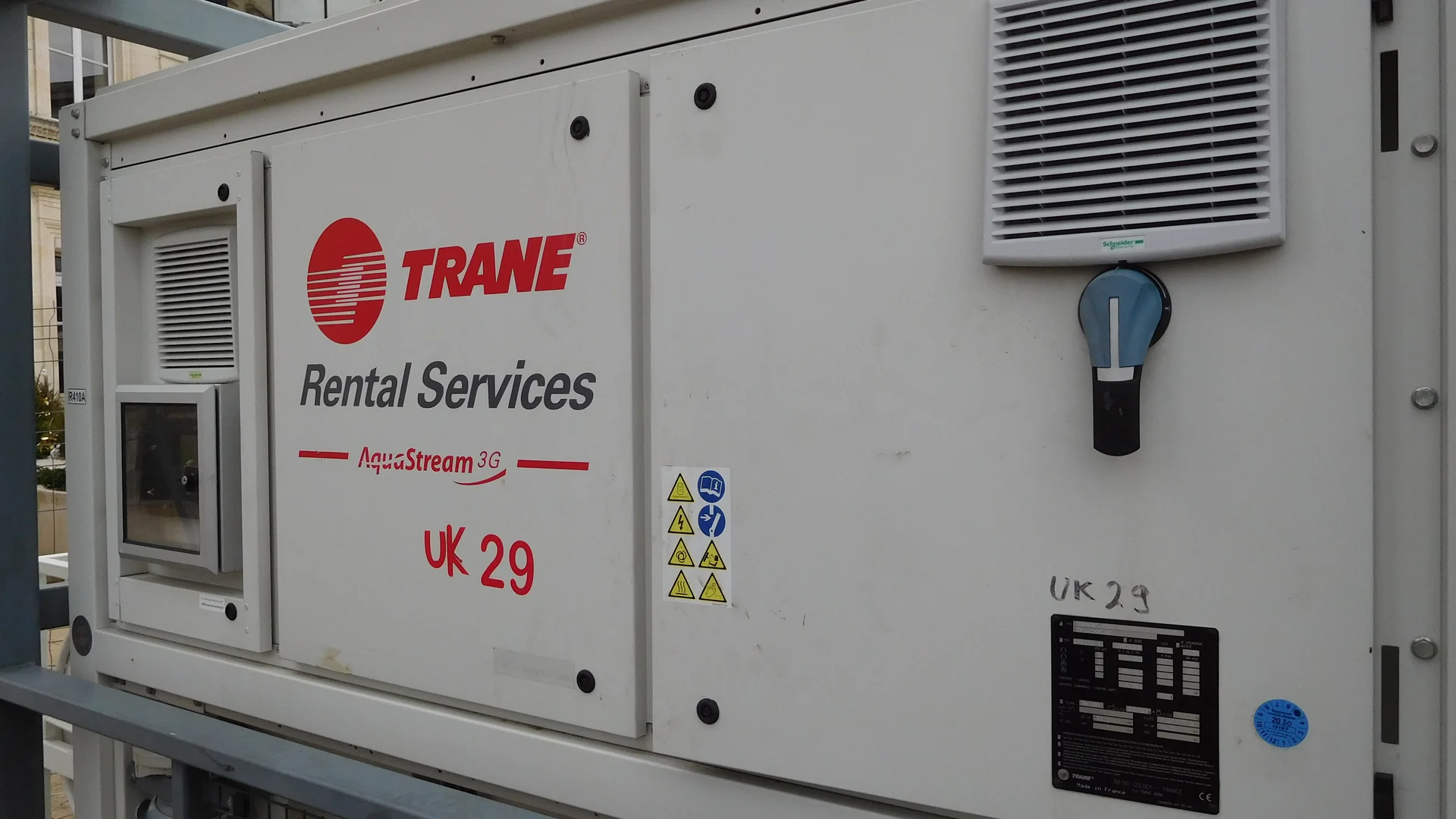
Dispatch reviewed Trane's September 28 and 30 releases and NVIDIA's architecture documentation. Industry-first and performance descriptions are company claims; Dispatch did not witness the test or inspect raw measurements. Thermal cooling capacity, electrical input voltage and efficiency are kept distinct. Reference-design projections are not combined with prototype measurements or presented as commissioned-site results. No interviews were conducted. The real archival Trane photograph is not the prototype; its cropped/resized derivatives remain available under CC BY-SA 4.0.
Sources
- Trane Technologies demonstrates an 800-volt DC chiller — Trane Technologies
- Two new AI-factory reference designs based on NVIDIA DSX — Trane Technologies
- NVIDIA 800 VDC Architecture — NVIDIA
- Original photograph: Trane AquaStream 3G chiller in France, 2020 — Wikimedia Commons
- Photo and resized derivatives: Creative Commons Attribution-ShareAlike 4.0 — Creative Commons