
Disclosure
TradeVulcan develops and sells software for home-service contractors and publishes TradeVulcan Dispatch. TradeVulcan has no reported financial relationship with Lowe’s, DoorDash, Wing, Alphabet or The Home Depot. Company product, delivery-speed and assortment claims are attributed to the cited sources. Contractor productivity, job-costing and operating implications are Dispatch analysis.
What changed — Sept. 24, 2026
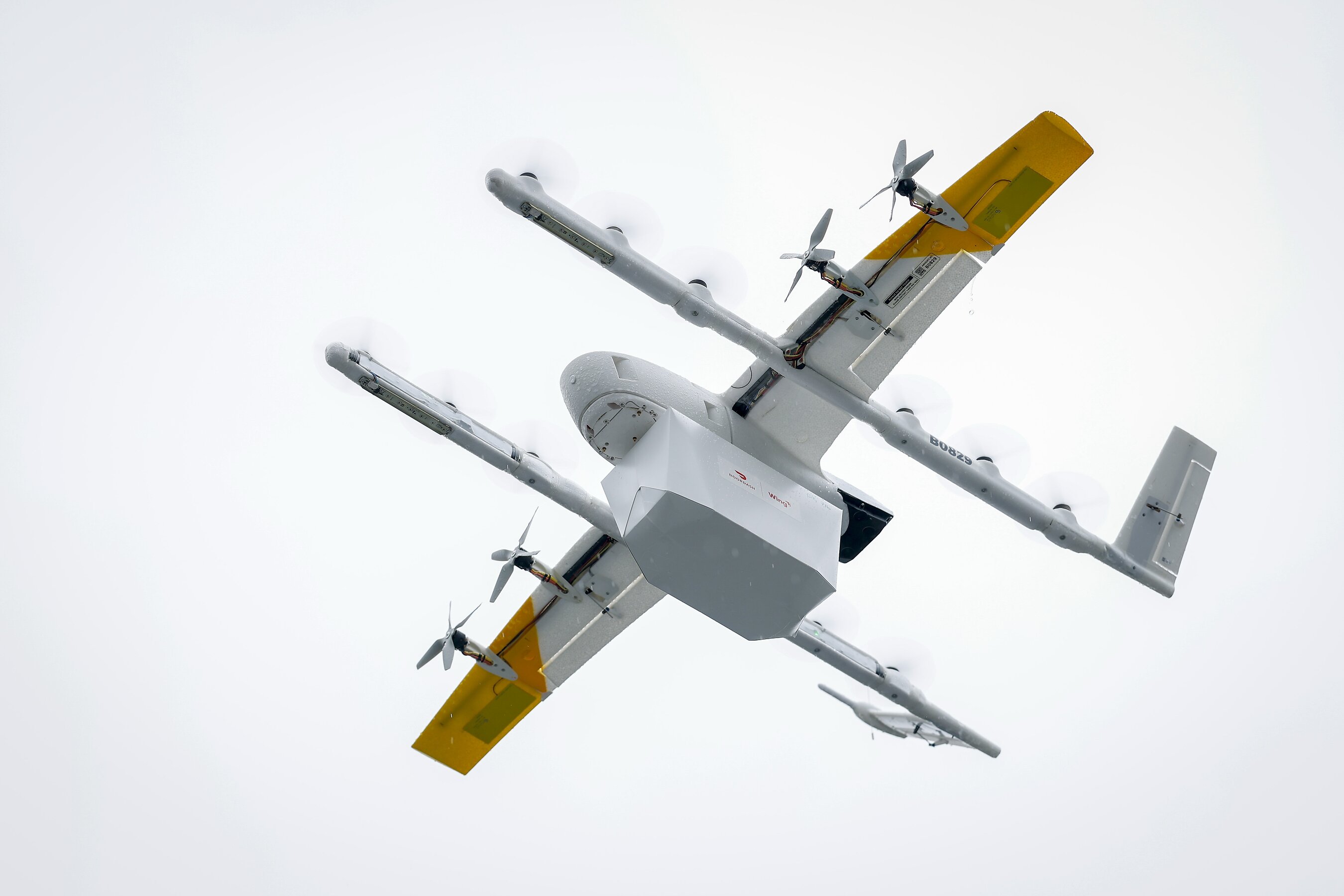
Lowe’s launched a drone-delivery pilot today at its Matthews, North Carolina store, becoming what the company describes as the first home-improvement retailer to offer drone delivery. Eligible DIY and Pro customers can order through a dedicated "Lowe’s by Drone" storefront in DoorDash and receive select items via Wing drones in as fast as 20 minutes.
The current aircraft payload is approximately 2.5 pounds per flight. Lowe’s says the eligible assortment includes hand tools, paint products and smaller household/project essentials such as soap, tape, all-purpose cleaner and batteries. Supply Chain Dive separately reports that more than 100 SKUs are available initially, including screwdrivers, painter’s tape and caulk, based on details provided by Lowe’s vice president of technology for stores.
The most interesting part of the pilot is not the drone. It is the supply run Lowe’s is trying to eliminate.
A service truck can carry tens of thousands of dollars in tools and inventory and still lose an hour because somebody forgot a three-dollar item.
That is the contractor version of the problem Lowe’s is testing in Matthews. The aircraft cannot carry a water heater, a condenser, a panel, a roll of Romex or a bundle of shingles. At roughly 2.5 pounds per flight, the first version is intentionally narrow. But the items that stop jobs are not always large. Tape, caulk, batteries, a small hand tool or another lightweight consumable can create a drive to the store, a checkout line and a second trip back to the job.
Lowe’s is testing whether that interruption can become a roughly 20-minute fulfillment event instead. If the model expands, contractors should not think of drone delivery as a replacement for a supply house or a stocked service vehicle. The more useful frame is emergency replenishment: a new layer between "we have it on the truck" and "send a technician across town to buy it."
What contractors should know
- The pilot is live at Lowe’s Matthews, North Carolina store in the Charlotte market and is available to eligible DIY and Pro customers.
- Orders are placed in DoorDash through a dedicated Lowe’s by Drone storefront and delivered by Wing aircraft.
- Lowe’s says delivery can take as little as 20 minutes and that the current payload is approximately 2.5 pounds per flight.
- The company’s release lists hand tools, paint products, soap, tape, all-purpose cleaner and batteries as examples of eligible items.
- Supply Chain Dive reports more than 100 SKUs at launch, including screwdrivers, painter’s tape and caulk, and says Lowe’s could expand the program to additional stores.
- The competitive backdrop is moving quickly: Home Depot rolled out nationwide Express Delivery in August and now advertises two-hours-or-less delivery for thousands of Pro and DIY SKUs.
- For contractors, the economic question is not whether a drone looks futuristic. It is whether a small urgent delivery costs less than the paid field time, vehicle time and schedule disruption of an emergency store run.
The pilot in six numbers
- Fastest stated delivery
- 20 min
- Current payload
- ~2.5 lb
- Initial assortment
- >100 SKUs
- Pilot location
- 1 store
- Lowe’s FY2025 sales
- >$86B
- Lowe’s retail footprint
- >1,750 stores
Lowe’s says eligible orders can arrive in as fast as 20 minutes.
Approximate Wing payload per flight in the Lowe’s pilot.
Supply Chain Dive, citing Lowe’s VP of technology for stores.
Matthews, North Carolina, in the Charlotte market.
Company-reported total fiscal 2025 sales.
Company-reported home-improvement store count in the Sept. 24 release.
The 2.5-pound limit is not a footnote. It explains the business case.
The easiest way to dismiss the pilot is to point at the payload. A home-improvement retailer sells heavy things, and a 2.5-pound drone order cannot touch most of them.
But that is also why the test is interesting. Last-mile speed has the highest value when the item is small, urgent and cheap relative to the cost of waiting. A contractor rarely sends a technician away from a job because the missing item is expensive. The technician leaves because the work cannot continue without it.
Consider the economics. A field employee who spends 45 minutes driving, shopping and returning is not merely burning fuel. The company can lose productive labor, delay the next appointment, create overtime later in the day and frustrate the customer whose schedule just moved. If two people are on the truck, the interruption can compound.
A drone delivery does not automatically solve that equation. The item must be eligible, the address must be inside the service area, weather and operating conditions must permit the flight, and the contractor still has to receive the package safely. But the test focuses on exactly the category where rapid delivery has a chance to beat a human supply run on total cost rather than just headline speed.
Where a lightweight delivery can fit a contractor workflow
| Example item | Why it can stop work | Operational value if eligible |
|---|---|---|
| Painter’s tape | Prep or finish work cannot proceed cleanly without the right tape. | Avoid a store run for a lightweight, low-dollar consumable. |
| Caulk | A missing tube can stop sealing, trim, fixture or finishing work. | Replenish a frequently forgotten consumable without pulling a field employee off site. |
| Batteries | Meters, lights, detectors and small tools can become unusable at the wrong moment. | Restore a tool or diagnostic workflow quickly when truck stock is empty. |
| Small hand tools | A lost, broken or missing screwdriver or similar tool can stop a specific task. | Replace the one item needed to keep the current job moving. |
| Tape and cleaners | Closeout, prep and cleanup can stall even after the technical work is complete. | Protect the schedule near the end of a call instead of turning cleanup into another errand. |
Lowe’s is not framing this as a homeowner toy — Pro customers are in the launch language
Lowe’s explicitly says the service is for both DIY and Pro customers, and its announcement repeatedly frames forgotten supplies as a jobsite problem as well as a homeowner inconvenience. That distinction matters because the professional customer has a different value equation.
A homeowner may pay for speed because leaving the house is annoying. A contractor can pay for speed because leaving the job is expensive. The product itself can be worth five dollars while the interruption costs many times more in labor and schedule capacity.
Lowe’s has spent years pushing deeper into Pro fulfillment. In 2023, it expanded same-day delivery nationwide through OneRail for orders placed on Lowes.com and its app, including delivery to jobsites. The drone pilot adds a much faster but far narrower layer to that same fulfillment stack.
That is also why the pilot belongs beside the retailer’s larger technology strategy. Lowe’s says its Mylow customer assistant and Mylow Companion associate assistant have answered more than 25 million questions since 2025. The company is trying to remove friction across discovery, in-store help and fulfillment. Drone delivery is the physical end of that chain: not another answer about what a customer needs, but a way to move a small item to the place where the work is happening.
Related Dispatch: Lowe’s is also investing upstream in the contractor labor pipeline
Lowe’s Wants 1 Million New Skilled-Trades Workers. Now Contractors Have to Keep Them.
The bigger race is fulfillment speed — and Home Depot has already reset the benchmark
Lowe’s is not making this move in a vacuum. Home Depot announced a nationwide Express Delivery rollout in August using more than 2,000 U.S. stores as neighborhood fulfillment hubs. Home Depot has since updated the promise from three hours or less to two hours or less for thousands of SKUs across plumbing, electrical, hardware, paint, tools and other project categories.
Those are different systems. Home Depot’s service can move a much broader assortment by conventional last-mile delivery. Lowe’s drone pilot is geographically tiny and payload-constrained. But both programs attack the same contractor pain point: the cost of discovering mid-job that something is missing.
That competition can change expectations even where drones never become the dominant delivery mode. Once two of the largest home-improvement retailers market "need it now" fulfillment to Pros, local distributors and supply houses face pressure to make inventory visibility, delivery windows and jobsite replenishment easier to use. Contractors, meanwhile, get more options for deciding when it is cheaper to deliver an item than to move a truck.
The strategic shift is from treating delivery as an e-commerce convenience to treating it as part of project uptime. That is a much more important idea than the aircraft itself.
Drone delivery is no longer a one-off demo in Charlotte
Wing and DoorDash already had a commercial drone-delivery footprint in Charlotte before Lowe’s joined it. Wing launched DoorDash-linked service in the market in May 2025, initially serving customers around The Arboretum shopping center. Wing’s current Charlotte page lists Matthews among the communities it serves and says the network has completed more than one million commercial deliveries to homes across its operations.
The broader delivery infrastructure is also maturing. DoorDash announced in July that its own DoorDash Labs operation earned FAA Part 135 air-carrier certification for an in-house drone program. That program is separate from the Lowe’s pilot, which uses Wing aircraft, but it is evidence that drone delivery is moving deeper into mainstream last-mile logistics rather than remaining only a technology demonstration.
Wing has been scaling with other large retailers as well. Its Walmart partnership has expanded across multiple metro areas, and Wing has described thousands of weekly deliveries with average fulfillment under 19 minutes in Dallas-Fort Worth.
None of that proves Lowe’s will roll drones across its national store base. The company is calling Matthews a pilot. It does show that Lowe’s is plugging into an existing operating network rather than inventing the aviation stack from scratch. That lowers the significance of the aircraft experiment and raises the significance of the retail experiment: which products, customers and use cases are valuable enough to justify ultra-fast delivery?
What this does not mean: the supply house is not being replaced by a flying box
Most trade work depends on inventory that is heavier, larger, more specialized or more tightly tied to professional distribution than this pilot can handle. Contractors also need account pricing, will-call, returns, warranty support, technical help, credit and predictable availability — services a 20-minute flight does not replace.
The service is also not universally available even around Matthews. Lowe’s says the DoorDash app will display drone delivery only when an address is eligible, and individual items must be eligible too. Dispatch is not treating the pilot as a guaranteed 20-minute service for every Pro, every order or every weather condition.
The right comparison is narrower. If the alternative is a technician leaving a job for one lightweight item, a drone may be economically useful. If the alternative is a scheduled material drop, a stocked service truck or a distributor delivering a complete project order, the drone may add little.
That distinction should guide contractor adoption. New technology earns a place in an operating system when it removes a measurable bottleneck, not when it merely looks advanced.
What a contractor should measure before ultra-fast delivery reaches the market
- Track emergency supply runs for 30 days. Record the missing item, employee time away from the job, vehicle miles and whether the interruption delayed the next call.
- Build a 'small but job-stopping' inventory list from actual field data. These are the items most likely to justify rapid replenishment or higher truck-stock minimums.
- Compare delivery cost with loaded field-labor cost, not with the retail price of the item. A five-dollar consumable can still justify paid delivery if it protects an hour of technician capacity.
- Set purchasing rules. Decide which field employees can authorize an urgent delivery, what dollar threshold applies and how the order is coded to the job.
- Keep truck-stock discipline. Drone or express delivery should cover exceptions, not become an excuse for weak replenishment and inventory controls.
- Preserve supplier relationships for technical and project-critical material. Ultra-fast retail delivery is another fulfillment option, not a replacement for distribution expertise.
- Watch actual coverage before marketing around it. Address, item, operating and weather eligibility can change; do not promise customers a delivery time your company does not control.
The Dispatch view
Lowe’s drone pilot is easy to turn into a novelty story because the visual is irresistible: a home-improvement order descending from the sky.
The contractor story is less theatrical and more useful. Field-service economics are full of tiny interruptions that rarely show up as their own line item. A technician forgets tape. A battery dies. A tool breaks. Somebody needs caulk. The truck leaves the job, and an expensive revenue-producing employee becomes a delivery driver for the next 45 minutes.
Lowe’s is testing whether one class of those interruptions can be compressed into a 20-minute logistics event. At only about 2.5 pounds, the pilot cannot solve the big-material problem. It is aimed at the small-item problem — and small-item problems are exactly the ones companies tend not to measure.
If the model expands, the competitive advantage for contractors will not come from being the first company to post a video of a drone. It will come from knowing the true cost of downtime well enough to decide, in real time, whether the right move is truck stock, distributor delivery, retail express or a package from the sky.
Methodology
Dispatch reviewed Lowe’s Sept. 24, 2026 corporate announcement, its official release multimedia, Supply Chain Dive’s same-day reporting and direct comments from Lowe’s technology leadership, The Home Depot’s current Express Delivery announcement, Wing’s Charlotte service materials, DoorDash’s July 2026 FAA Part 135 announcement and Lowe’s earlier nationwide same-day-delivery rollout. The >100 SKU figure is attributed to Supply Chain Dive because Lowe’s public release describes the assortment but does not publish a count. Dispatch distinguishes DoorDash Air from the Lowe’s pilot: Lowe’s orders are delivered by Wing drones through the DoorDash marketplace. Contractor labor-cost, truck-stock and jobsite-productivity implications are analysis rather than company claims. The hero is an authentic Lowe’s-issued press photograph downloaded at the original 2700×1800 resolution from the release’s PR Newswire media endpoint; no AI generation, compositing or fabricated event imagery was used.
Sources
- Lowe’s Becomes First Home Improvement Retailer to Offer Drone Delivery — Lowe’s Companies, Inc.
- Lowe’s debuts drone delivery pilot with Wing, DoorDash — Supply Chain Dive
- The Home Depot Expands Fastest Fulfillment in Home Improvement with Nationwide Express Delivery — The Home Depot
- Wing and DoorDash tee off first-ever drone delivery service in Charlotte — Wing
- Wing drone delivery — Charlotte — Wing
- DoorDash Is Cleared for Takeoff: Launches DoorDash Air, Our In-House Drone Delivery Program — DoorDash
- Lowe’s Expands Same-Day Delivery Service Nationwide for Pro and DIY Customers in Partnership with OneRail — Lowe’s Companies, Inc.
- Wing drone carrying Lowe’s project essentials — official release multimedia — Lowe’s Companies, Inc. / PR Newswire