
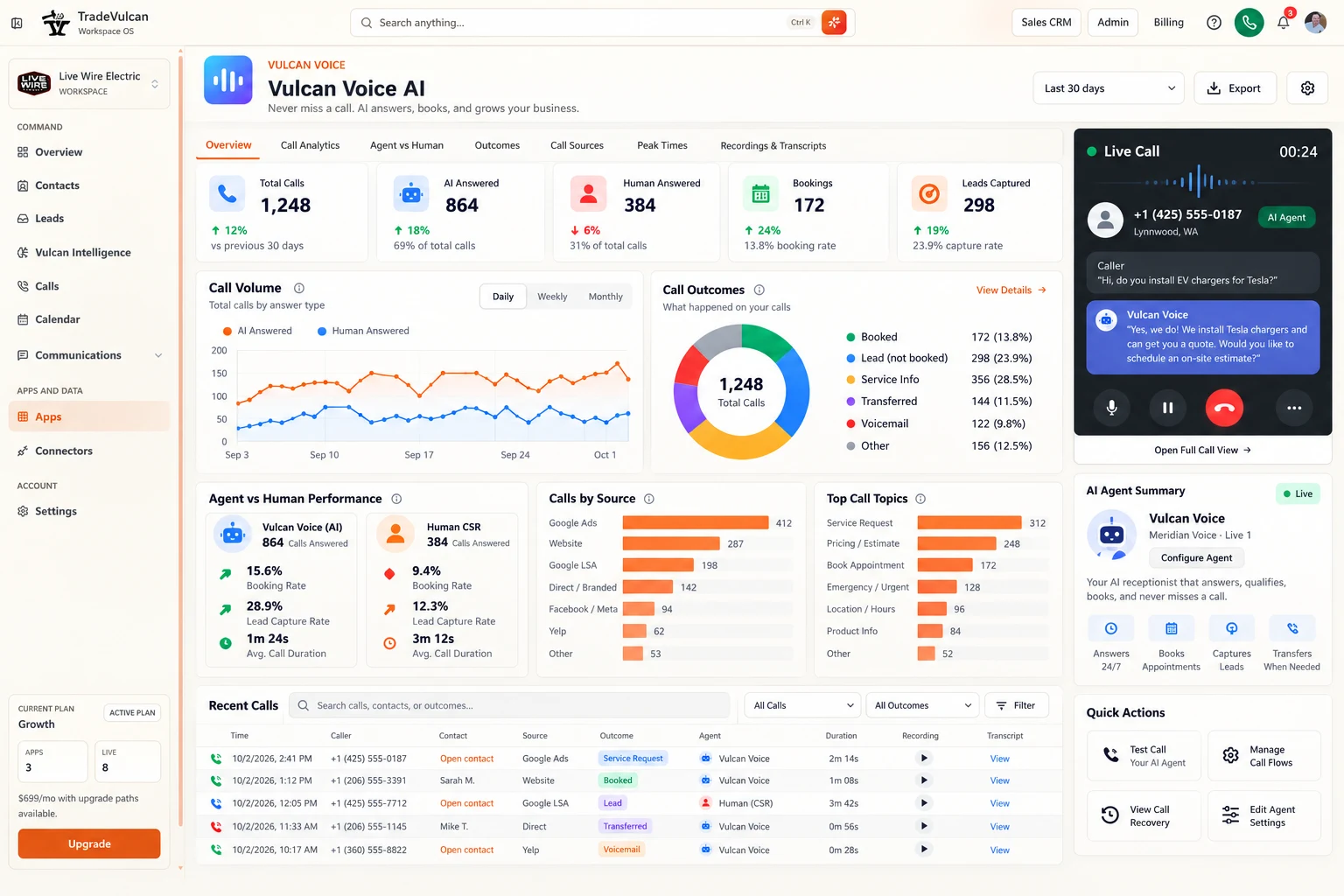
Start with one customer interaction
The dashboard counts Voice-origin customer interactions in the selected start-date range and filters. Linked observer and human-transfer connections do not create extra customer calls. Separate Call Spark and Sales Voice records retain their own reporting scope. A caller who makes a separate call later can create another interaction; Total Calls is not unique customers.
The five summary cards
| Card | Definition | What it does not mean |
|---|---|---|
| Total Calls | All matching customer interactions, including records with unresolved or unknown evidence. | Unique customers, leads or completed jobs. |
| AI Answered | Calls with evidence of AI as the initial answering handler. | Every call routed toward an AI line, or only calls handled entirely by AI. |
| Human Answered | Observed human-first calls when coverage exists. Current Voice-origin reporting shows N/A when that coverage is unavailable. | All staff calls across your business or AI calls later taken over by staff. |
| Bookings | Calls with a current confirmed CRM appointment and external record evidence. Canceled appointments are not current bookings. | Booking requests, unscheduled jobs or revenue. |
| Calls with Captured Leads | Matching calls linked to a saved lead. These calls can also have a booking. | Necessarily new or unique people, or only unbooked leads. |
Rates and denominators
Verified booking rate = calls with verified appointments ÷ all matching calls × 100. The denominator includes the full selected call cohort, not just answered calls or qualified opportunities. Changing an outcome, source or handler filter changes that denominator.
Observed answer rate = (AI-first answered + observed human-first answered) ÷ all matching calls × 100. Unknown handling is excluded from the answered numerator, but stays in the call total. Missing coverage makes this an observed rate, not proof of your complete business phone answer rate.
A manual captured-lead percentage can be calculated as calls linked to saved leads divided by matching calls. Label it clearly if you calculate it outside the app; do not confuse it with a separate qualified-lead conversion rate or a unique-customer metric.
Worked example
Suppose the selected report contains 100 calls, 20 verified booked calls and 30 calls linked to leads. If 12 of those lead-linked calls also booked, the lead-not-booked group is 18—not 30. Booking rate is 20%. The two summary counts cannot be added to claim 50 separate successful calls.
If booked calls increased from 16 in the prior period to 20 now, the count increased 25%: (20 − 16) ÷ 16 × 100. If a booking rate moved from 15% to 20%, that is a five-percentage-point change; it is not the same calculation.
Duration and comparison arrows
Average call duration uses completed interactions with observed duration boundaries. Ongoing calls and missing duration are not inserted as zero-second calls. The previous-period comparison uses the same number of local calendar days immediately before the selected range. When the prior count is zero, the percentage change is unavailable rather than an invented infinite increase.
Do not interpret a green increase as proof of better service. More calls can reflect spam, longer coverage or more advertising; fewer human-first observations can reflect missing data. Review outcomes and sample calls before changing staffing or routing.
Timing has a separate meaning
First AI Voice Latency measures observed stream setup to the first voiced AI audio. Its median (p50) and p95 summarize calls with captured timing. It is not telephone answer time or the delay between every caller question and agent response. Telephone answer latency and historical after-hours classification are currently N/A when their underlying evidence is unavailable.