
Disclosure
Company press release issued by TradeVulcan, the publisher of Dispatch. This is promotional coverage of TradeVulcan’s own product, with a sourced industry deep dive—not independent reporting or a comparative product test. AI agents perform the supported production work; customers retain approval responsibility.
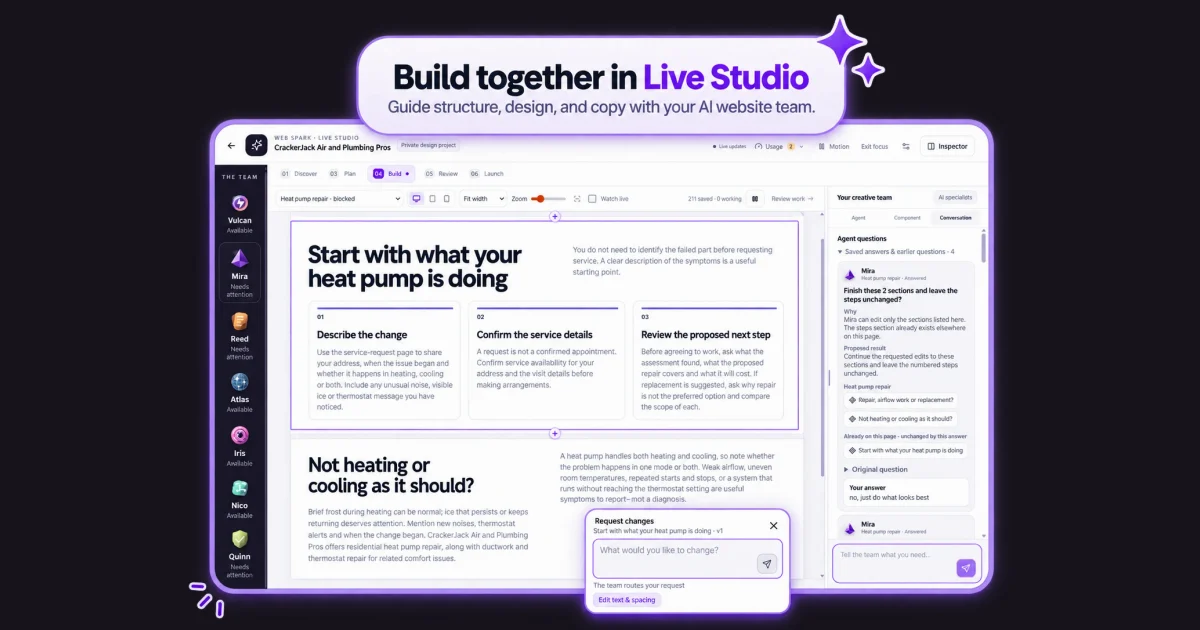
September 27, 2026 — TradeVulcan is launching Web Spark, an AI-agent-led web design offering for the home services industry. The new studio gives HVAC companies, plumbers, electricians, roofers, garage door businesses and other contractors a coordinated website team they can direct through a shared visual workspace.
The proposition is an agency-style service model delivered through software: a creative director coordinates specialists in design, copy, site architecture, imagery, customer journeys and review. The business owner supplies the facts, steers the direction and approves the website before it goes live.
For contractors searching for a home service web design company, Web Spark offers a different starting point from a brief sent into an agency inbox or a template handed back for the owner to finish alone. The conversation stays attached to the pages being built.
A web design team you can direct—not a website you have to start over
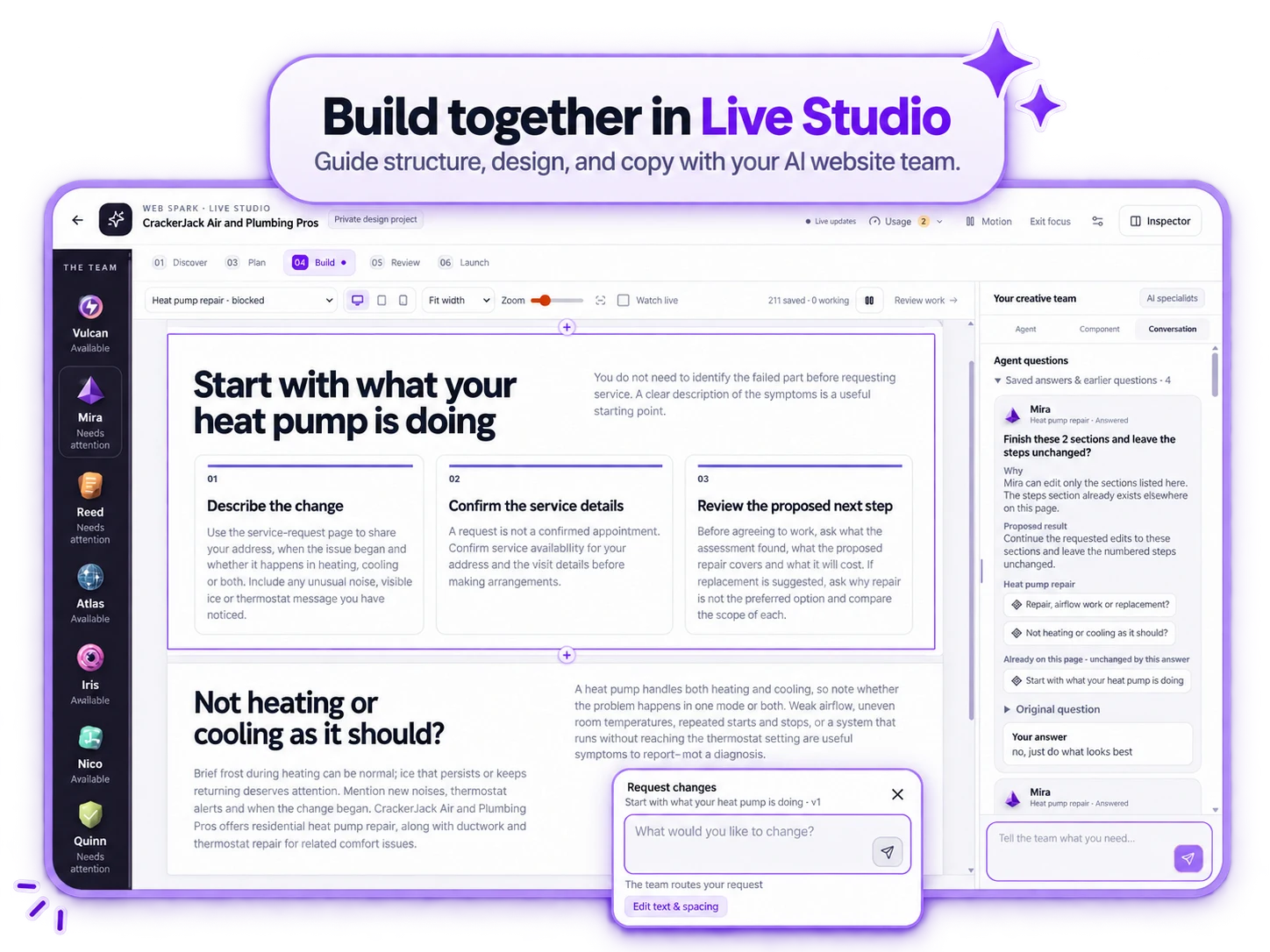
Web Spark combines a six-stage Studio workflow with seven named AI agents. Customers can plan a site, inspect design direction, request changes to a specific section, add new sections, review findings and prepare a release. Website builds, hosting and domains have distinct costs and approvals. Optional human Expert Assist is a separate service when available.
What an AI-run web design agency means in practice
“Agency” describes the coordinated delivery model here, not a claim that software has replaced every human responsibility. Web Spark’s agents carry out supported production tasks inside the Studio. The customer still knows the real service territory, licenses, offers, warranties, crew and customer experience. Those facts have to come from the business.
That division of labor matters. A strong contractor website should not invent a five-star review, advertise emergency availability the office cannot support, or promise financing that has not been approved. The same goes for publication: a draft can be ready for discussion without being ready to represent the company in public.
Web Spark is designed around those handoffs. The owner directs the team rather than managing every individual design task, while the review and release process keeps the final decision visible.
What is agentic web design?
An AI website generator can create a starting layout or draft copy. Agentic web design goes further: it uses AI-driven task execution to work through a project, use available tools, respond to the current state and prepare changes for review. In a multi-agent system, different responsibilities can be assigned to different specialists.
Anthropic’s engineering guidance distinguishes predefined workflows from agents that dynamically direct their own processes and tool use. Real products can combine both approaches. A polished chat interface alone does not establish that an agentic workflow exists.
For a contractor, the practical test is simple: can the system identify the right page, understand what should change, preserve approved facts, save the result and let the owner inspect it before publication? A conversation about a website is not the same as work performed on the website.
The AI website landscape is moving beyond the first draft
The broader market is already moving in this direction. Wix’s current AI website builder pairs its Aria agent with manual visual editing. Its documentation describes generating pages and continuing to change the site through the same editor. Webflow’s AI site builder creates a multi-page starting point, content and a customizable theme rather than only a single image of a design.
Framer describes agents that create and refine editable pages on its canvas. Relume now presents both a publishing path and an export path, with planning, wireframes and a component-based site system. These are the vendors’ descriptions of their own products, not results from a Dispatch comparison test.
The common direction is important: AI is becoming part of the ongoing website workflow, not just a way to produce a rough mockup. That means the competitive question is shifting from “can it generate a page?” toward “can the team control, maintain and improve the site after the first generation?”
Wix AI website builder ↗Webflow AI site builder documentation ↗Framer AI canvas agent ↗Relume planning, publishing and export ↗
Why Web Spark focuses on home-service contractors
Web Spark is not claiming to be the first AI website builder, nor that other platforms cannot serve contractors. Its focus is the home-service workflow: explain the actual work, organize services and communities, establish trust and make the next customer action clear.
A contractor website often has to serve several different intentions. One visitor needs a repair now. Another is planning a replacement. A third is comparing warranties, financing or service-area coverage. Sending all three to a generic homepage with a single paragraph about quality leaves important questions unanswered.
The opportunity for a specialized website studio is to help turn those intentions into a coherent site plan. That includes recognizing when a page needs more information, when two pages repeat the same purpose and when a business claim should wait for owner confirmation.
Meet the seven-agent Web Spark team
| Agent | Specialty | Contribution to the website |
|---|---|---|
| Vulcan | Creative director | Coordinates the vision, priorities and specialist work. |
| Mira | Art direction | Shapes layouts, color and responsive visual design. |
| Reed | Conversion and copy | Writes useful service explanations and calls to action. |
| Atlas | Architecture and search | Plans page structure, navigation and search-aware organization. |
| Iris | Brand and imagery | Pairs approved brand assets with appropriate imagery. |
| Nico | Connections and journeys | Connects supported forms, booking and customer contact paths. |
| Quinn | Independent review | Reviews visual, content and accessibility issues separately from drafting. |
How a contractor website moves from brief to launch
Web Spark’s Studio is organized into Discover, Plan, Design, Build, Review and Launch. The business brief establishes the service scope, audience, territory and public facts. The plan gives each proposed page a purpose. The design direction defines how the website should look and feel.
Once work is saved, the owner can inspect it in the canvas and request a change at the relevant page or section. An instruction such as “keep our approved offer, shorten this introduction and make the service request more prominent” is connected to the work instead of becoming another disconnected email.
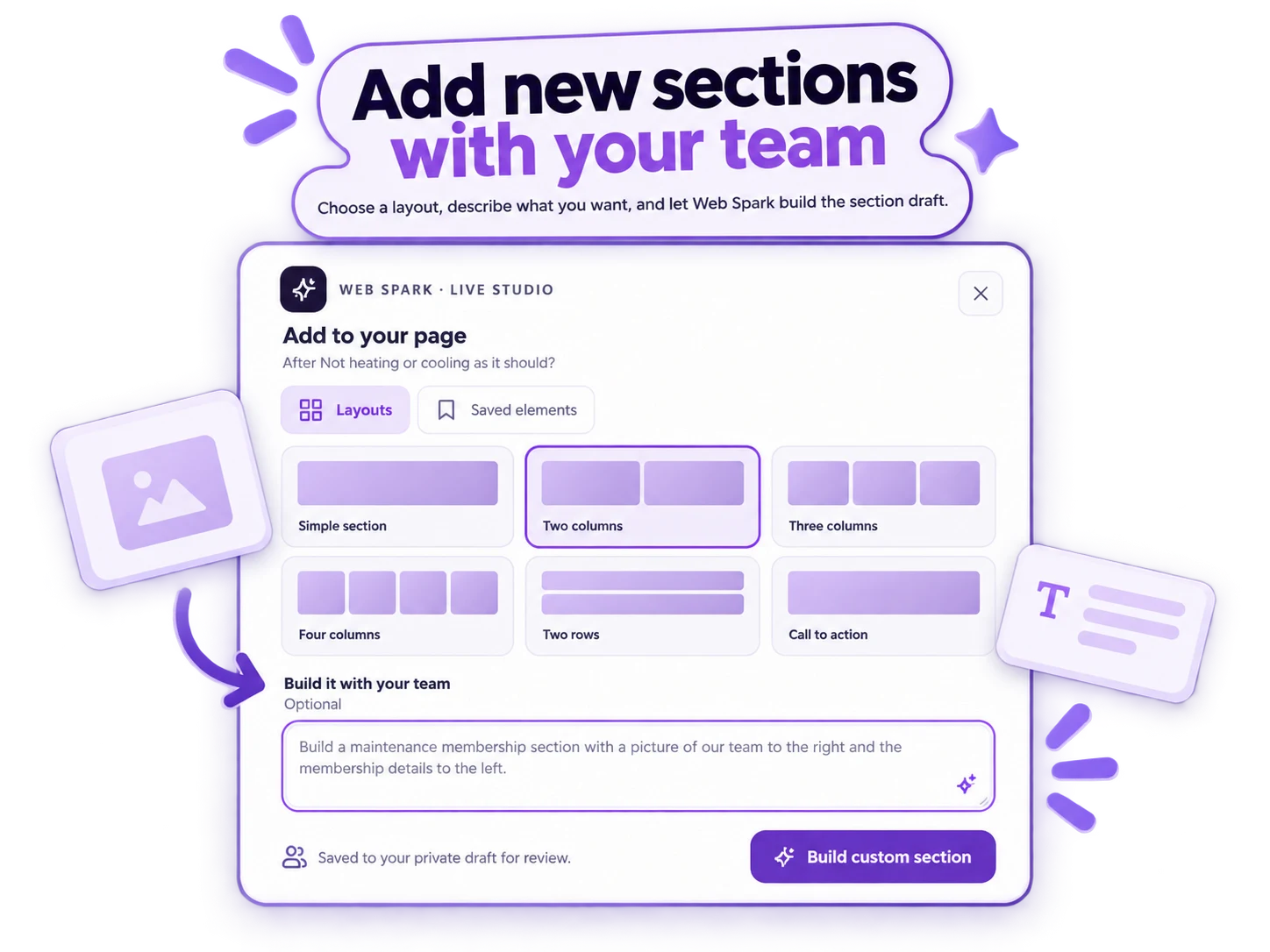
The Add to your page flow lets the user select a layout and describe a custom section, such as membership benefits alongside an owned team photograph. New work goes into a private draft for review. Completing a generation or approving a visual direction is not the same as approving a public release.
HVAC website design: repair, replacement and maintenance are different journeys
For an HVAC company, a useful website plan can separate furnace repair, heat pump service, air conditioning installation and maintenance. A repair visitor needs symptoms, availability and a clear contact action; a replacement shopper needs process, scope and an explanation of what requires an assessment.
Web Spark can be directed toward those distinct page purposes rather than treating “HVAC website design” as a single homepage template. Contractors should supply the actual systems they service and the terms they can honor. The website should not manufacture equipment certifications, rebate eligibility or guaranteed response times.
Plumber website design: explain the problem and the next step
A plumbing website can organize urgent leaks, drain and sewer concerns, water heaters and planned upgrades around understandable service paths. The owner’s job is to confirm the scope and tell the team what is not offered; the design team’s job is to turn that information into readable, useful pages.
A strong instruction might be: “Build a water-heater service page that explains repair versus replacement assessment, shows our approved installation process and directs visitors to request service. Do not promise a fixed price before inspection.” That is more actionable than asking for a page stuffed with plumbing keywords.
Electrician website design: make technical services understandable
Electrical contractors need to explain services such as panel upgrades, troubleshooting, EV charger installation and generator projects without asking homeowners to diagnose their own systems. A website should make it easy to describe the problem and contact the company.
The owner can direct Web Spark to prioritize high-intent services while keeping safety language, qualifications and project claims grounded in approved business information. Real team photography and a recognizable brand can support the story, but the design should not use generated project imagery as proof of completed work.
Roofing and garage door website design: show real scope, not generic promises
Roofing and garage door businesses can use the same planning approach for repair, replacement, maintenance and specialty work. Relevant project evidence, clear service descriptions and accurate territory information are more useful than a long list of cities with identical text.
For a roofing website, ask what a visitor needs to understand before requesting an assessment. For a garage door website, separate repair needs from replacement choices. These are examples of how to direct the Studio, not claims about completed customer projects in those trades.
Contractor website design and local SEO: structure is the starting point
A home service website design company should be able to explain more than its color choices. Contractors should ask how service hubs, individual service pages, location information, headings, metadata and contact paths work together. They should also ask what happens when an existing URL changes and who reviews the new content before it is published.
Google’s guidance permits useful applications of generative AI but warns against producing large amounts of content without added value. Its spam policies also address doorway abuse and keyword stuffing. The lesson for an AI-built contractor website is not to generate every possible service-and-city combination; it is to publish pages that answer real questions with accurate, distinctive information.
Web Spark’s search-aware planning and website output provide a foundation. They do not guarantee indexing, rankings, calls or revenue. A page-generation allowance measures creation capacity, not search quality. Business reputation, competition, content and the actual customer experience still matter.
Google: using generative AI content ↗Google Search spam policies ↗Web Spark service and location planning guide ↗
What useful service-area content looks like
Consider the difference between a page that only changes a city name and one that explains whether the company actually serves the address, which services are available, what customers can expect and where to go next. The second gives the visitor a reason to read it.
A contractor can provide neighborhood-specific project examples, service constraints or local operating information where those facts are real and useful. It should not invent offices, customer stories or local expertise to make a page appear more relevant. The site plan should follow the business, not create a fictional footprint for it.
The next frontier: dependable production, not just impressive generation
The emerging web-design landscape combines several approaches: prompt-driven drafts, visual editing, reusable component systems and agents that can act on a project. These are not mutually exclusive. A component system can give an agent a stable design vocabulary; a visual canvas can give the owner a place to inspect the result.
The difficult work begins when the website changes. A new service page must fit the navigation. A revised offer must preserve its conditions. A replacement photograph must be licensed and readable on a phone. A domain cutover must not break the contact path. The useful question is whether the system can keep those relationships intact while making a requested change.
That is where agency-style coordination becomes valuable. The owner should be able to see what was requested, what was saved, what still needs an answer and which version is being approved. The value is a more understandable working process, not a claim that every generated draft is perfect.
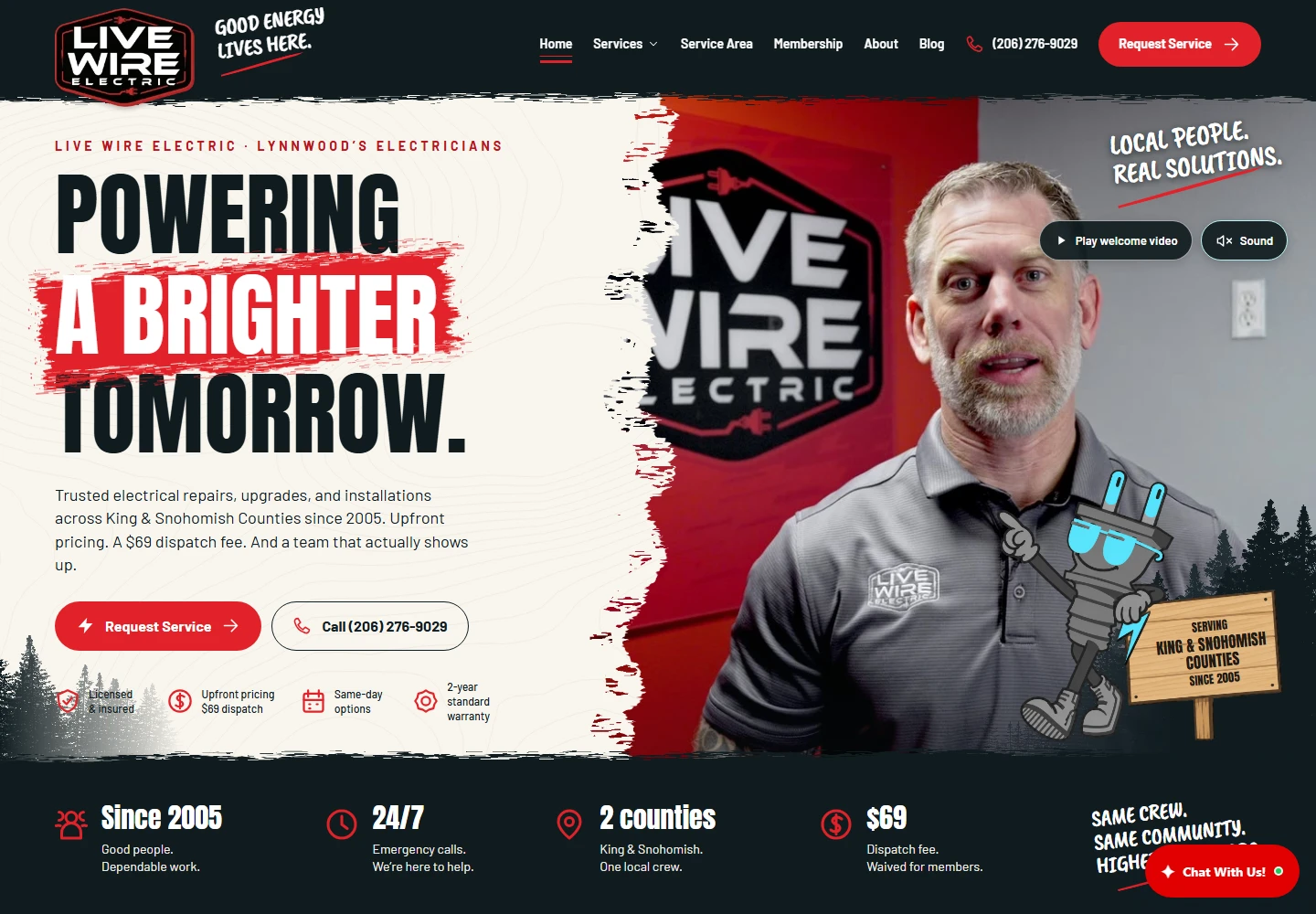
A contractor website example: Live Wire Electric
Live Wire Electric’s website provides a concrete design story in the Web Spark showcase. The electrical company’s presentation uses a red, ink and warm-cream palette, large condensed headlines, regional tree silhouettes, the Sparky mascot and a prominent personal welcome. Its service navigation separates repair, panels and power, lighting, EV charging, backup power, and wiring and safety.
The site also presents a searchable community directory and prominent telephone and service-request actions. The accompanying case study explains those choices and includes real desktop and mobile browser captures. It is a useful example of how brand personality and practical structure can coexist without turning the homepage into an undifferentiated list of services.
The case study documents the design and website structure. It does not attribute a measured ranking, lead or revenue increase to Web Spark.
Website design should lead somewhere useful
A website’s next step matters as much as its visual presentation. Web Spark supports connections to eligible Site Spark and Proof Pulse deployments in the same workspace. That can connect website content with supported forms, booking-related paths and proof experiences. Availability, configuration, permissions and separate subscriptions still apply.
For the business, the important test is the entire journey: the visitor finds a relevant page, understands the service, chooses an action and reaches the right team or source application. A submitted inquiry should not be mislabeled as a confirmed appointment. A configured integration should be tested on the actual public domain.
Those distinctions help a contractor evaluate any web design partner. The deliverable is not only a set of attractive pages; it is a website with clear, working paths to the business.
What does a Web Spark contractor website cost?
The published starting build price is $899.99 for Web Spark Launch, with 200 page generations and 20 initial creative assets. Growth is listed at $1,500 for 500 page generations and 50 assets; Scale is listed at $2,499.99 for 1,000 page generations and 100 assets. These are creation allowances, not a promise that every generated page will be published or individually written by a human.
Managed hosting is separate, with published Essential, Performance and Enterprise prices of $29.99, $99.99 and $299 per month. Hosting uses AWS delivery and supports HTTPS, versioned releases and approval-based publishing. Domain registration and renewal are quoted separately; connecting an existing domain has no connection fee in the standard flow.
Optional Expert Assist is listed separately at $2,500 when available and staffed, with a defined scope rather than unlimited agency hours. Additional generation, AI usage and connected tools can have their own allowances or costs. The current catalog, accepted quote and availability shown for the website govern the purchase.
Web Spark pricing ↗Billing, credits and Expert Assist guide ↗
Questions to ask any home service web design company
- What business facts and brand assets will you need from us, and who approves the final content?
- How will HVAC, plumbing, electrical or other service pages fit into a useful site plan rather than a collection of duplicates?
- Can we inspect and request changes to a specific page or section without restarting the whole project?
- What are the one-time build charges, recurring hosting fees, domain costs, revision allowances and optional service costs?
- How are mobile layouts, contact paths, privacy text and publication checked before the site goes live?
- What happens when we add a service, change a domain, update an offer or need to restore an earlier version?
Watch Web Spark, then learn how to use it
The Web Spark public broadcast gives prospective customers a window into selected saved website previews. The viewer shows the current presentation status; it is not a promise that all agents are continuously editing, and it does not expose every customer’s private project.
A new Web Spark documentation collection also covers the practical work behind the presentation: first-time setup, the seven agents, business briefs, service and location planning, design direction, page editing, review, connections, launch, hosting, domains, billing, history and troubleshooting. The goal is to make the next step understandable before a contractor has to open a support ticket.
Questions contractors ask about AI web design
Is Web Spark a traditional web design agency or an AI website builder?
It is an agency-style, AI-agent-led website offering delivered through TradeVulcan’s Studio. Specialists handle supported production tasks while the business owner directs and approves the work. Optional human Expert Assist is a separate service with a defined scope.
Can it support HVAC, plumbing, electrical and roofing website projects?
Web Spark is designed around home-service website planning and customer journeys. Owners provide the actual services, locations, assets and approved claims for their business; the team prepares and refines the corresponding website.
Does an AI-built contractor website automatically rank in Google?
No. AI assistance does not guarantee indexing, rankings or leads. Useful content, accurate business information, a clear structure and ongoing review remain essential. Large numbers of near-duplicate pages are not a substitute for quality.
Can we use an existing domain and keep updating the website?
Web Spark has an existing-domain connection flow and supports reviewed draft updates and publication. Domain ownership, HTTPS, hosting and connected origins must be checked. Review the current hosting, history and transfer terms for the project.
A new option for contractors choosing their next website partner
For home-service owners comparing a contractor web design agency, a do-it-yourself builder or an AI-assisted website platform, Web Spark puts the creative team inside the product. The business supplies its real identity and priorities; the agents help turn them into a website that can be inspected, refined and released deliberately.
The launch is about bringing agency-style coordination to a specific industry—not removing the contractor from the decisions that shape the business. Explore the Studio, review the Live Wire Electric example, and use the setup guides to see how the process fits your next website project.
About TradeVulcan
TradeVulcan develops software for home-service businesses, connecting customer-facing experiences, business workflows and AI-assisted work. Web Spark is its agentic website studio. TradeVulcan also publishes Dispatch, which labels company announcements separately from independent editorial reporting. Product information and demonstration requests are available through the Web Spark page and TradeVulcan’s contact page.
Methodology
Original company announcement with an industry-context section researched September 27, 2026. Product descriptions were checked against the current Web Spark source, public product page and customer-support workflow. Wix, Webflow, Framer and Relume descriptions are attributed to their official pages, not a hands-on comparative benchmark. The agent definition draws on Anthropic’s engineering guidance; SEO guidance links to Google Search Central. The Live Wire example is a design and structure review, not an attribution study. Existing company-owned AI-assisted illustrations are labeled; the Live Wire desktop image is an actual browser capture. No independent launch interview, customer performance lift, market-size estimate, search-volume dataset or industry-first claim is asserted. Pricing is the published catalog at preparation; accepted quotes govern purchases.
Sources
- Web Spark product, workflow and published pricing — TradeVulcan — company product information
- Web Spark setup and support collection — TradeVulcan — product documentation
- Live Wire Electric website design and structure case study — TradeVulcan — company case study
- Live Wire Electric homepage, services and community directory — Live Wire Electric
- Wix AI website builder and Aria — Wix — official product description
- Build a site with Webflow’s AI site builder — Webflow Help Center
- Framer AI canvas agent — Framer — official product description
- Relume marketing website planning, publishing and export — Relume — official product description
- Building effective agents — Anthropic Engineering
- Google Search guidance on generative AI content — Google Search Central
- Spam policies for Google web search — Google Search Central